This year, intellectual property (IP) law and policy directly addressed the realities of generative artificial intelligence (AI). With a new director at the helm, the U.S. Patent and Trademark Office (USPTO) issued new guidance for AI-assisted inventions. On the litigation side, the Federal Circuit issued its first Alice analysis for machine learning patents in Recentive Analytics, Inc. v. Fox Corp., et al. 2023-2437, addressing subject matter eligibility under § 101. And several federal district courts weighed in on fair use in the context of training generative AI. AI is also reshaping industries, including the life sciences, with the FDA issuing draft guidance for AI use in medical devices, drugs, and biologics.
Globally, the European Union implemented the world’s first comprehensive legal framework for AI through the Artificial Intelligence Act, setting enforceable requirements that already affect how AI systems are developed, deployed, and licensed, including for U.S. companies. Other major jurisdictions, including the United States, China, and Brazil, are advancing parallel AI governance regimes that rely heavily on deployment and procurement controls and that increasingly shape technical design choices around auditability, traceability, provenance, and safety.
We also saw law firms innovate and leverage AI technology in IP practice. In March 2025, Sterne Kessler introduced Patent Assist AI, a proprietary tool designed to streamline patent specification drafting. In addition, we launched our internal R&D team, Sterne Kessler Labs, which is responsible for building, testing, and integrating AI technology into our IP practice.
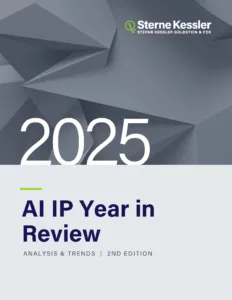
In our second edition of AI IP Year in Review, we present a comprehensive overview of the legal decisions, policy updates, and technology developments that defined AI and IP in 2025. This report builds on the insights we shared throughout the year, highlighting the trends, practical implications, and strategic considerations for businesses and innovators as they navigate an increasingly complex and rapidly evolving IP and AI landscape in 2026.
The information provided in this review is the result of a collaborative process. We would like to extend our thanks to our contributing authors, whose efforts have enriched this publication.
We appreciate your interest in this report, and we encourage you to read our firm’s other recently released publications: 2025 Design Patents Year in Review: Analysis & Trends, 2025 PTAB Year in Review: Analysis & Trends, Federal Circuit IP Appeals: Summaries of Key 2025 Decisions, and 2025 ITC Year in Review: Analysis & Trends, which are available here. Please contact us if you have questions about this report or would like to discuss AI and IP issues.
Table of Contents
Governance & Global Developments
- Regulatory Update: FDA Issues Draft Guidances for AI Use in Medical Devices and for Drugs and Biologics
- AI Regulation Meets Innovation: IP Considerations as the EU AI Act Takes Effect
- AI Regulation in 2025 (Around the World): What IP Lawyers and In-House Counsel Need to Know
Patents
- Key Takeaways from the Federal Circuit’s First Alice Analysis for Machine Learning Patents
- USPTO Issues New Inventorship Guidance for AI-Assisted Inventions
- Navigating the Crossroads of AI Patent Eligibility: Translating USPTO Optimism into Long-Lasting Protection
- Patent Protection for AI Technologies: Navigating § 101 After Recentive Analytics
- Navigating Patent and IP Risks in AI-Powered Blockchain and Crypto Technologies
- Key Takeaways—AI-Equipped Medical Devices Require Speculative Patent Approach
Copyright & Creative Ownership
- The Market Harm Dilemma: What Bartz and Kadrey Reveal About Fair Useʼs Future in Generative AI
- First Federal Ruling Rejects Fair Use Defense for AI Training Data in Copyright Dispute
- The (Media) Empire Strikes Back—An Update on Disney et al. v. Midjourney Inc.
Litigation, Misuse & Ethical Boundaries
 Download
PDF
Download
PDF
Related Industries
Related Events
Receive insights from the most respected practitioners of IP law, straight to your inbox.
Subscribe for Updates