World Space Week, held each year from October 4–10, is the largest global celebration of space science and technology. Established by the United Nations in 1999, it highlights how space exploration contributes to the betterment of life on Earth and inspires the next generation of innovators. This year’s theme, “Living in Space,” focuses on the technology that makes space a habitat. As we look toward establishing long-term human presence on the Moon, Mars, and in low Earth orbit, the technologies that enable sustainable living are critical.
To join in the celebration, we are highlighting recent patented and patent-pending inventions that improve “Living in Space” and open space habitation to a broader pool of future astronauts. Patent protection by government agencies and private industry developing emerging space habitability technology reflects the promising commercial opportunities available to innovators in the “space.”
Water Recovery & Recycling
On long-duration missions, every drop counts. U.S. Patent No. 10,336,637 (Assigned to NASA) describes a bioregenerative water treatment system designed for closed-loop recovery on the International Space Station (ISS) and Mars missions.
The patented invention reduces losses due to waste in the water purification system aboard the ISS. Specifically, the proposed solution includes a closed-loop system that integrates biological treatment (e.g., nitrifying bacteria) to break down waste compounds like urea, membrane and UV systems for pathogen removal, and ammonia and brine separation to maximize water reuse. The patent also describes that the process can convert currently wasted inputs into useful products for various applications, including propulsion, breathing air, and plant fertilizers.
Advances in sustainability and efficiency during space travel can unlock extended human exploration to, for example, Mars, and ensure viable living conditions when humans arrive.
Interior Environment Control
Condensation can be a challenge for long-term human habitation in sealed environments. Moisture accumulation on cold interior surfaces can lead to corrosion, microbial growth, and damage to electrical systems. Also, as space-craft transition from primarily metal construction to composite materials, new surface heating designs that address the generally poor conductivity of composite materials can be essential to avoiding undesirable condensation and contamination.
U.S. Patent No. 11,827,383, assigned to Sierra Space, covers a new surface heating device that more evenly distributes heat and minimizes power consumption for composite spacecraft. The patent describes a layered system that includes a heating film embedded in or adjacent to wall insulation, uniform temperature regulation to maintain internal surfaces above dew point and enhanced thermal control with lower energy expenditure compared to ambient heating.
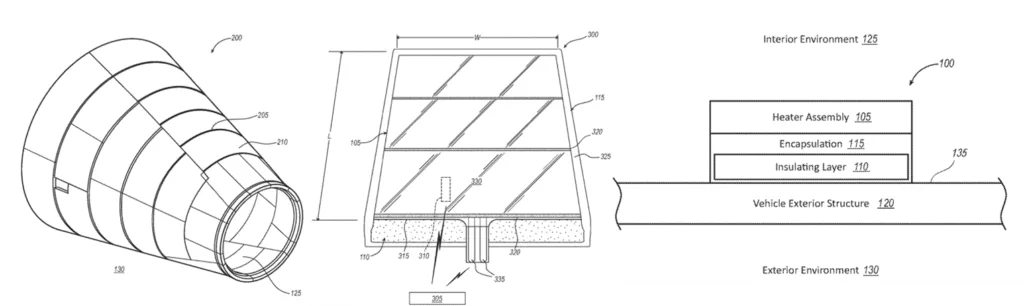
This type of interior environment management may be especially important for next-gen habitats, where passive safety systems will be crucial to long-term livability.
Emerging Habitat Designs
As the ISS nears retirement in 2030, companies like Vast, LLC are racing to build the next generation of orbital habitats. Vast’s Haven-1 module, planned for launch as early as 2026, will be one of the first commercial microgravity space stations designed for human habitation, research, and private astronaut missions. Future designs aim to scale and eventually introduce artificial gravity. While Vast has yet to receive a publicly issued U.S. patent, the company has described patent-pending innovations, including a uniquely designed astronaut sleep system.
New habitat designs, especially those incorporating advanced features such as artificial gravity and high-speed internet connectivity, can supply the infrastructure necessary for long-duration missions, enabling not just survival but a higher quality of life for crew members.
As 2025 Space Week comes to a close, it’s clear that these inventions, and many others, are shaping our ability to live and thrive beyond Earth so that Space is not just a destination, but a place to stay. The legal protections behind these breakthroughs help ensure that innovation is rewarded and commercialized, paving the way for sustainable, long-term human presence in orbit and beyond.
Related Industries
Related Services
Receive insights from the most respected practitioners of IP law, straight to your inbox.
Subscribe for Updates