Data we analyzed from January 2024 through this April indicates that despite the sustained strength in patent application filings and a marked decline in inter partes review and post-grant review petitions under the current administration, U.S. patent litigation has not surged in 2026, contrary to industry predictions.[1]
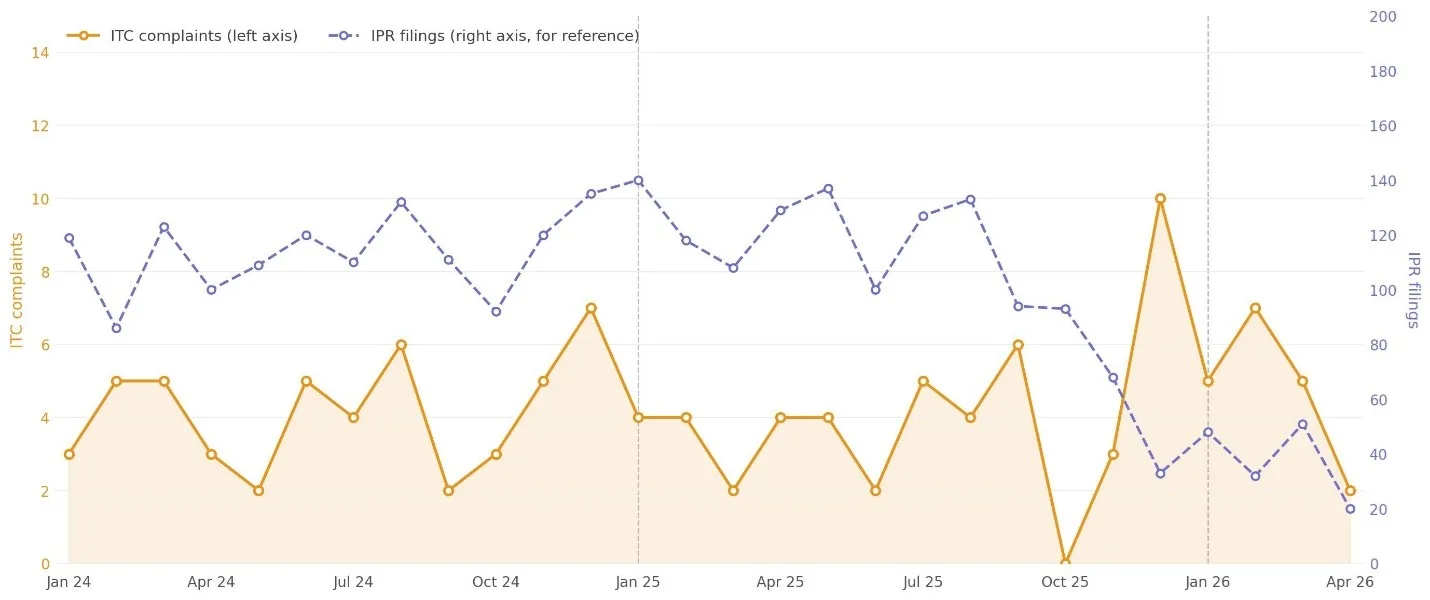
New district court patent complaints are down year to date compared to 2025, with similar softening of the number of U.S. International Trade Commission petitions. At the same time, ex parte reexamination filings have increased, signaling a shift in defensive tactics for accused infringers.
It appears that overall, the changes at the Patent Trial and Appeal Board have functioned less as a mechanism to channel litigation to district courts and the ITC and more as a systemic change where IPR challenges come earlier, or patent challengers turn to other options within the U.S. Patent and Trademark Office.
Simultaneously, the unpredictability associated with the new PTAB procedures and practices has likely increased settlement pressure in the face of rising litigation costs. Patent filings in district courts and the ITC may also be dictated by uncertainty about venue and the likelihood of success in litigation.
Changes at the PTAB Under the New Administration Have Caused a Slowdown
The past year has seen significant changes in practice and procedures at the PTAB that have resulted in dramatic shifts in institution rates, and more recently a significant reduction in petition filings.
Institution rates at the PTAB started to fall in 2025, with the recission of the Fintiv memo,[2] the implementation of a bifurcated institution process,[3] and the announcement of several new discretionary factors, including so-called settled expectations.[4]
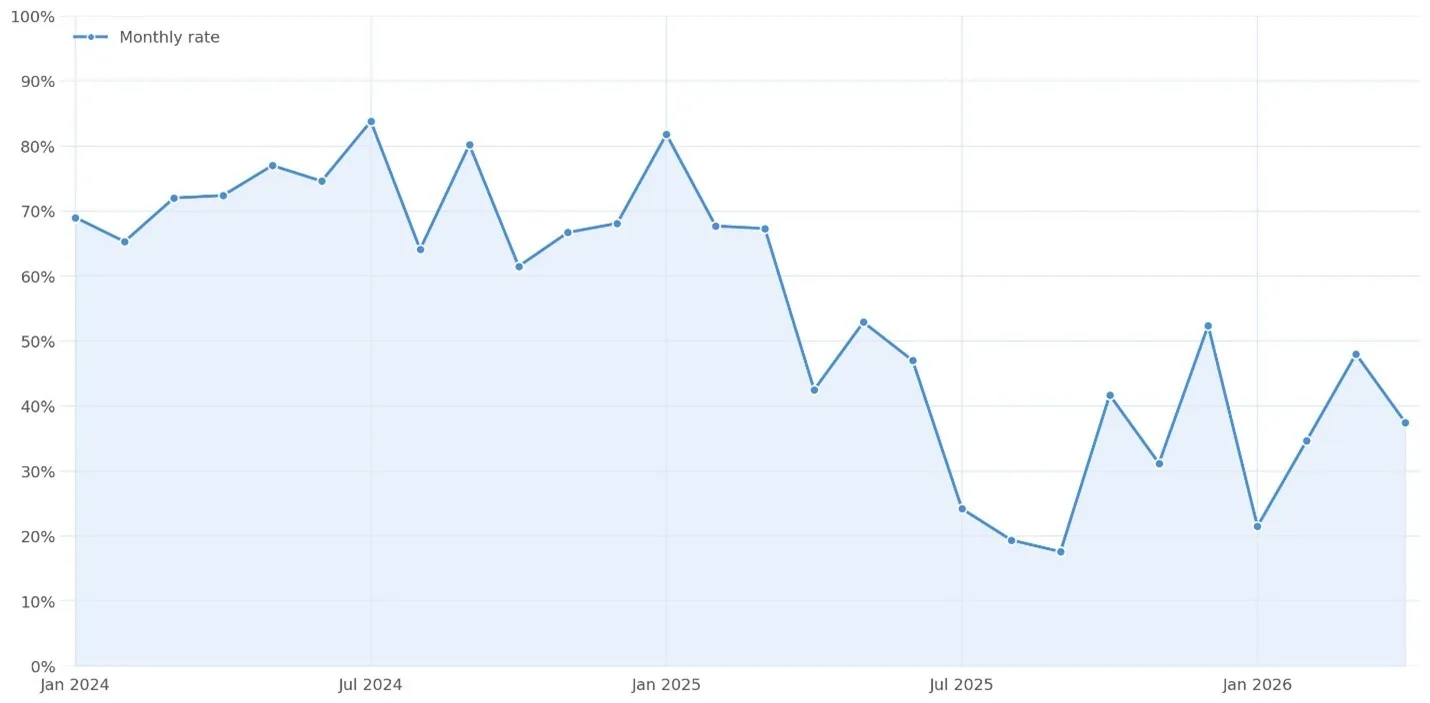
Institution rates have fallen from the historical average of around two-thirds of cases being instituted to nearly the inverse, with institution rates under USPTO Director John Squires averaging just below 30%. The graph below illustrates both the historical trend, with 2024 having an average monthly institution rate around 70%, and the sharp decline in institution rates seen in 2025 into 2026.[5]
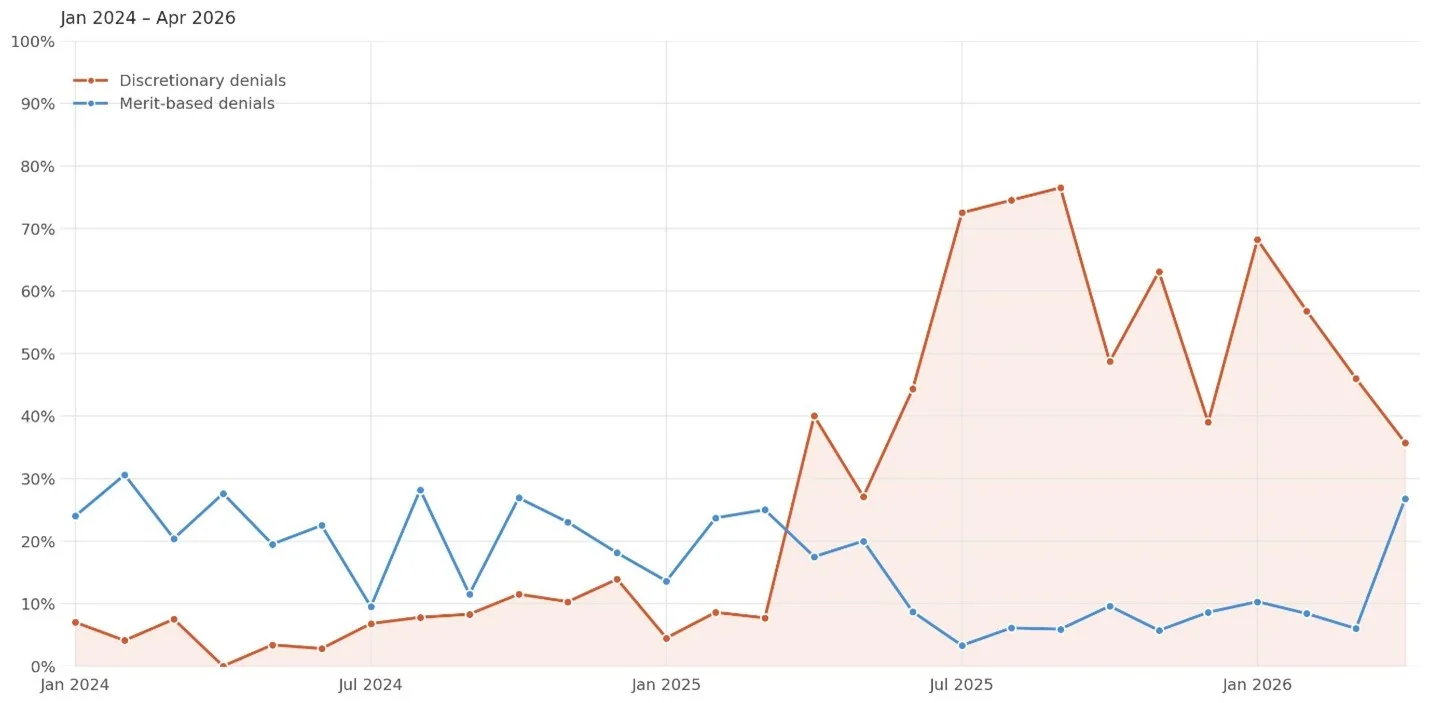
The graph below illustrates the percentage of institution decisions in a month that were denials on the merits or denials based on discretion; the balance of decisions were decisions instituting trial.[6] The data show that the majority of denials in the past year have been based on discretion, which is a significant change from historical practice at the PTAB.
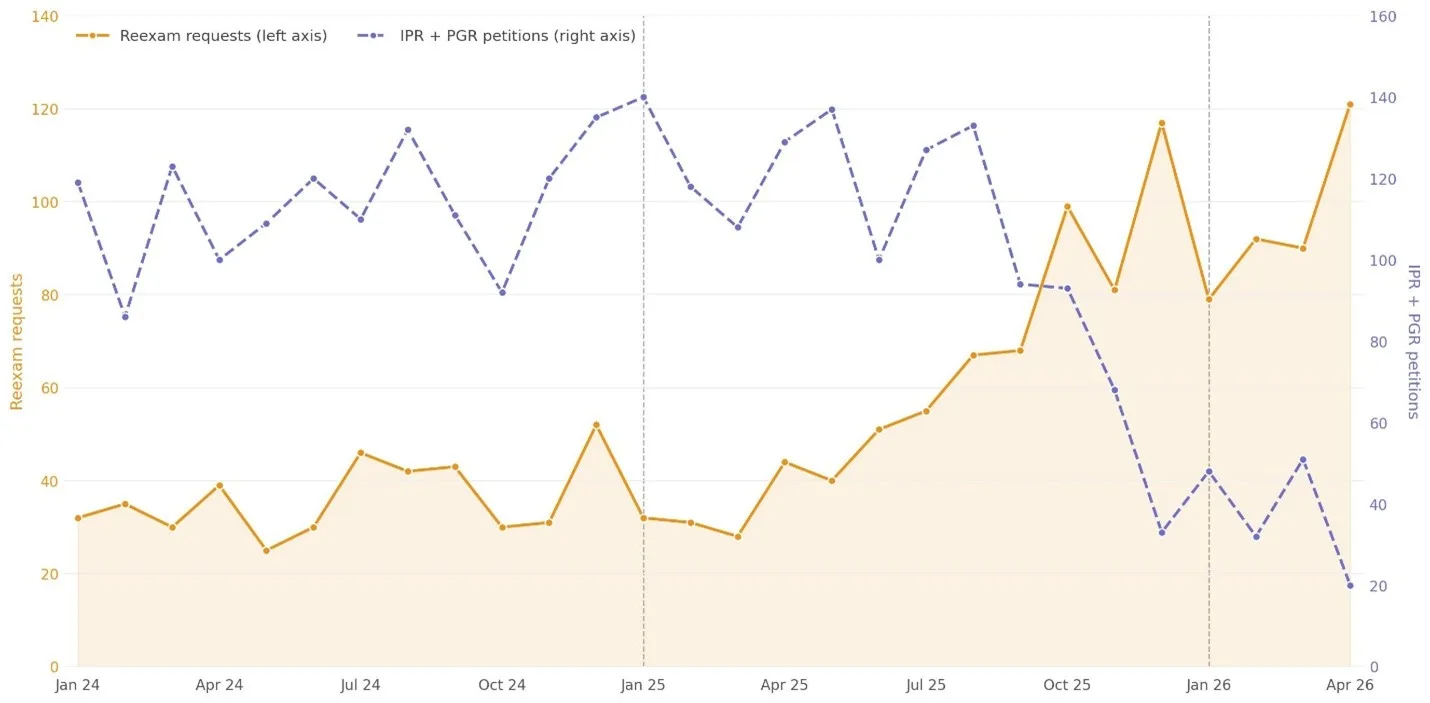
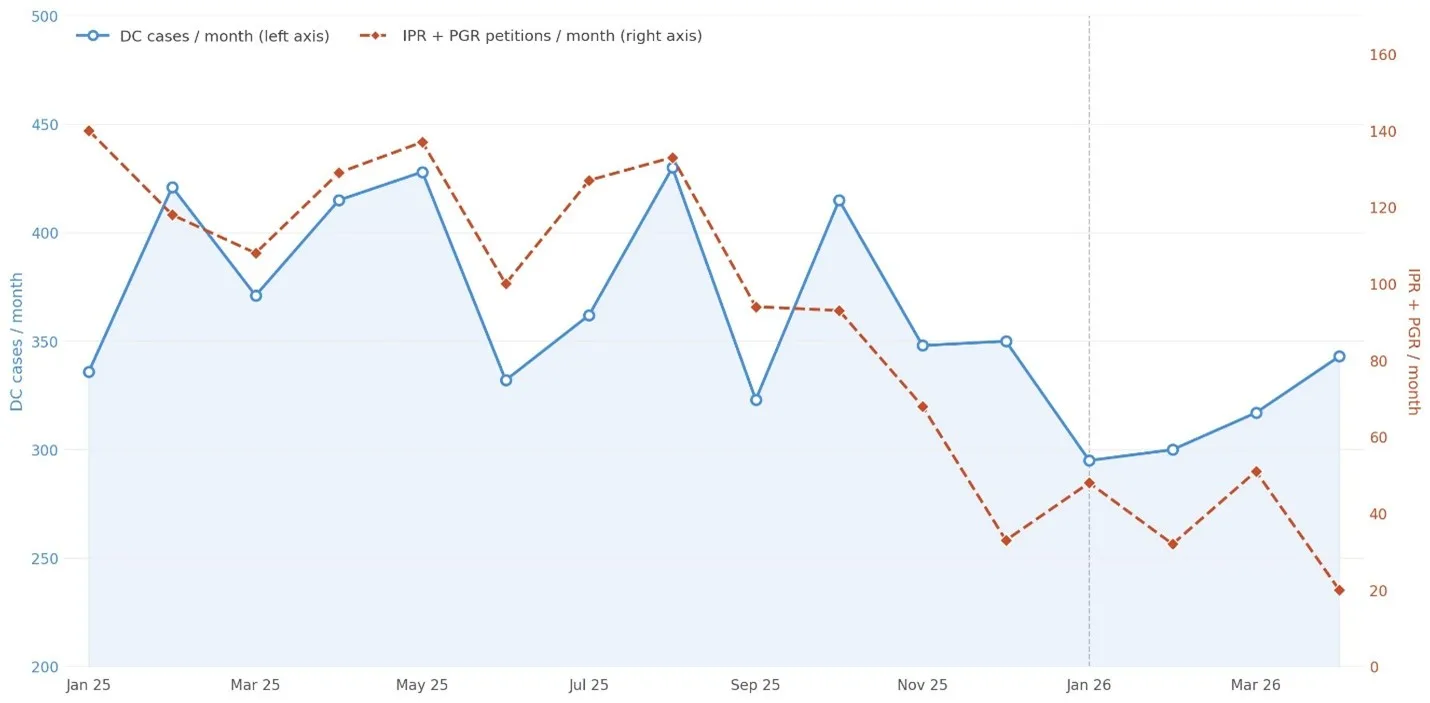
In response to the changes at the PTAB, patent challengers have shifted their focus to ex parte reexaminations. The data shows a correlation between increased reexamination requests and the initiation of new PTAB procedures and practices concerning discretionary denial in February and March 2025.[7]
However, there remains uncertainty in the viability of pursuing ex parte reexamination as a path for challenging patent validity.
The USPTO recently published an official gazette notice announcing that patent owners can now provide information to central reexamination unit examiners prior to the USPTO’s determination of whether the reexamination request establishes a substantial new question of patentability, which is required by statute to grant a reexamination.[8]
This suggests that the USPTO may be taking a harder look at reexamination requests, potentially leading to a decrease in the historically high grant rate of around 95%.[9]
Further, Title 35 of the U.S. Code, Section 325(d), which allows the director to deny a reexamination request if “the same or substantially the same prior art or arguments previously were presented to the Office,” also applies to reexaminations. In the past, the USPTO has applied Section 325(d) sparingly to reexamination proceedings, but with the significant increase in filings, it remains to be seen if this will change going forward.
Older Patents Remain Unasserted in the Face of Settled Expectations
Many believed that the dwindling IPR institution rates would lead to an increase in patent assertions in district courts and at the ITC.
In particular, the PTAB’s new settled expectations consideration, which favors denial of institution for patents that have been in force for over six years,[10] was believed to potentially cause an increase in the assertion of older patents.
This does not appear to be the case. All patents must nonetheless go through the normal vetting process to ensure they can withstand validity challenges at reexamination, the district court or the ITC.
Simply put, the number of assertable older patents has not changed. All that has changed is the risk of facing a validity challenge at the PTAB for those patents.
As of yet, this decreased risk of a PTAB challenge has not motivated patent holders of older patents to notably increase assertions. Indeed, as shown below, the number of overall district court complaints and ITC petitions in 2026 have largely stayed steady or decreased month-to-month compared to 2025. Even the recent uptick in district court complaints filed in April this year remains well below most months of 2025.
Uncertainty and the Cost of Litigation
Uncertainty is likely a refrain for many parties contemplating litigation. There is overwhelming uncertainty surrounding discretionary denial and other new developments at the PTAB.
But independently of the new procedures at the PTAB, there is always uncertainty regarding the likelihood of success, especially in the face of increasing litigation costs. These uncertainties may also make litigation funders more reticent to, or skeptical of, funding plaintiff-side cases.
Take the new practice and procedures at the PTAB. These new practices have only recently been implemented, and they are currently being challenged. Google, for example, petitioned the U.S. Supreme Court to hear whether the USPTO has the statutory authority to deny IPR institution based on settled expectations.[13]
Patent plaintiffs may be waiting and monitoring the longevity of the PTAB’s rule changes before revising their overall litigation strategies to increase district court or ITC litigation in the event that settled expectations, or other new discretionary denial practices, fall by the wayside.
Increased litigation costs also tend to factor into whether to pursue litigation — parties weigh the costs of litigation against the likelihood of success. Litigation costs are especially a concern for non-U.S. entities who are unused to the high comparative costs of discovery in the U.S.
Persuit, an intelligence platform that tracks legal spend for in-house counsel, reported that over the past five years, U.S. patent litigation typically cost anywhere from $2.1 million to $7.7 million, with a median spend of $4.1 million. These costs likely vary with higher damages exposure and as the number of asserted patents increase.
To initiate expensive litigation in an ever-shifting IPR landscape presents risk that many patent owners cannot swallow, especially if settled expectations and other discretionary denial factors suddenly change.
Mandatory Disclosures of Litigation Funding
Relatedly, litigation funders may be more skeptical to take on risk and fund plaintiff-side litigation in the face of high costs, uncertain outcomes and mandatory disclosure requirements.
In recent years, nonpracticing entities have been behind a majority of filings in the top patent venues.[14] These companies benefit the most from litigation funding and there is a correlation between increased patent litigation and the availability of litigation funding.[15]
Studies surmise that mandatory disclosure requirements typically deter nonpracticing entities and litigation-funded plaintiffs[16] from filing in top patent jurisdictions like New Jersey, Delaware and the Northern District of California.[17]
With the recent proposed rule at the International Trade Commission to “require disclosure of information by the parties and intervenors in section 337 investigations and ancillary proceedings,” a similar chilling effect could occur at the ITC.[18]
Venue and Jury Dynamics
As a result of the U.S. Supreme Court’s 2017 decision in TC Heartland LLC v. Kraft Foods Group Brands LLC, patentees are more limited in the choice of proper venue.[19]
As a result, the proper venue for a particular case may be in a district less experienced with patent cases or in a district that does not have specialized patent procedures or local patent rules that tend to provide the predictability and guidance of districts with historically extensive patent experience.
Plaintiffs who might otherwise have pursued parallel district court or ITC actions may have limited venue options — options viewed to be unfavorable due to the lack of predictability resulting from a lack of local patent rules or historical data for patent cases.[20]
Take, for example, the U.S. District Court for the Western District of Texas.
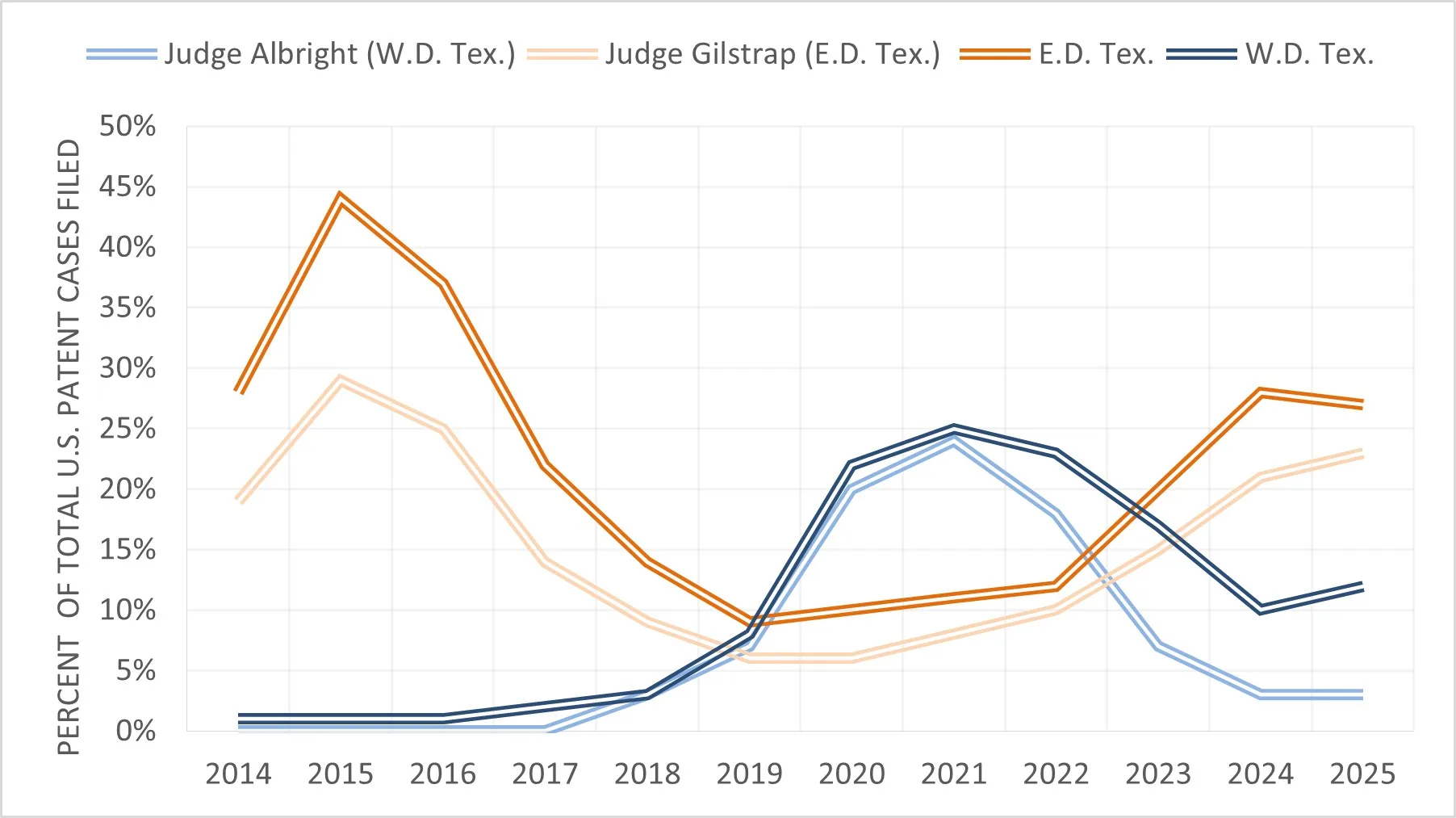
Historically, the Western District of Texas was not a popular venue for patent cases. But after U.S. District Judge Alan Albright’s appointment in 2018, the district became a hotspot for patent filings, in part because filers knew what to expect with Judge Albright’s procedures and practices.[21]
At its peak in 2022, nearly 25% of all patent cases were filed in Western District of Texas, and Judge Albright was assigned to about 20% of all U.S. patent cases.[22]
But after the Western District of Texas changed its patent-case assignment practices, patent filings in the district declined to roughly 12% of filed patent cases, with Judge Albright’s share dropping to about 3% in 2025.[23]
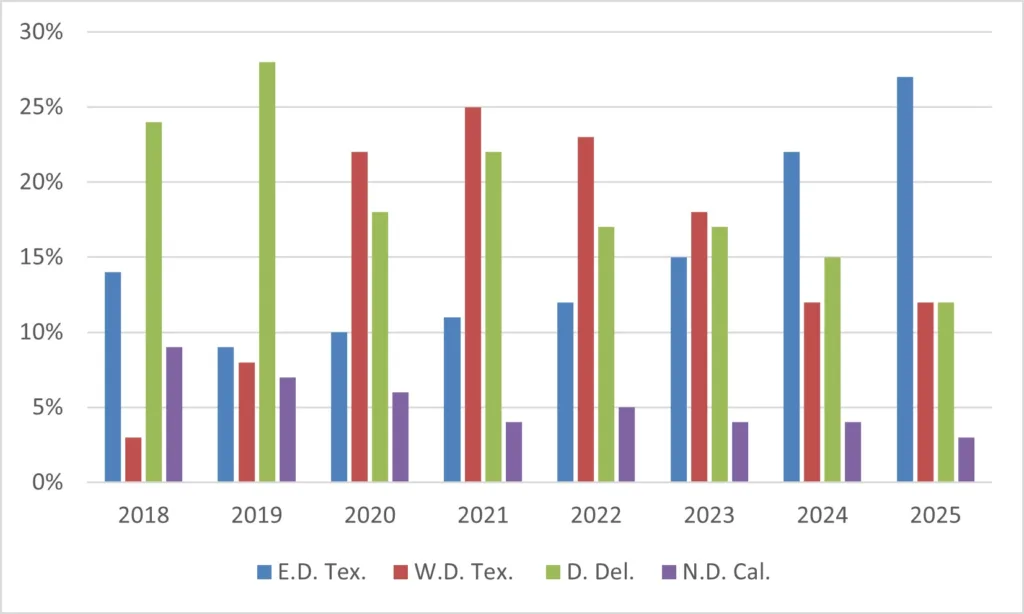
Meanwhile, filings in the U.S. District Court for the Eastern District of Texas, as well as filings in Marshall, Texas, saw a corresponding increase — from about 11% of patent cases filed in Marshall in 2021 to approximately 27% in the Eastern District overall, with 23% of patent cases pending before U.S. District Judge James Rodney Gilstrap in 2025.[24]
As the procedural changes in the Western District of Texas reduced the perceived predictability of procedures and practices in the district, plaintiffs shifted to venues with known practices, like the Eastern District of Texas, while Judge Albright’s announced retirement has further increased uncertainty surrounding patent case assignments and procedures in the Western District of Texas.[25]
Plaintiffs may prioritize Delaware for its relative predictability, the likelihood venue is proper given the high number of entities incorporated in Delaware and the court’s deep experience with patent litigation.
By contrast, the U.S. District Court for the Northern District of California is often perceived as less favorable to plaintiffs because the jury pool is viewed as sympathetic to resident technology companies.
Jury dynamics are another consideration for plaintiffs in deciding where and whether to file a patent case. The jury pool in the Eastern District of Texas, for example, has historically been viewed as more receptive to patent plaintiffs at trial, thus partially explaining the venue’s popularity, in addition to the predictability of practices and procedures with local rules, etc.[28]
On the other hand, venues like the Northern District of California are often perceived as more skeptical of patent assertions, particularly in cases involving well-known, local technology companies.[29]
Conclusion
Despite lower PTAB institution rates, there has not been a significant increase in patent enforcement cases filed in the district courts or the ITC. Instead, uncertainty across forums, including evolving PTAB procedures, USPTO reexamination practices and district court dynamics, appears to be influencing how parties pursue enforcement and validity challenges.
As predictability declines across forums, parties may place greater emphasis on early validity strategy and settlement rather than materially increasing district court or ITC filings. The second half of 2026 will show if these uncertainties continue to suppress patent disputes.
Originally printed in Law360 on June 3, 2026. Reprinted with permission.
[1] Serialized UPR Applications Filed: FY2021 (450,457), FY2022 (457,576), FY2023 (462,242), FY2024 (466,089), and FY2025 (475,223). “USPTO annual reports,” USPTO, https://www.uspto.gov/about-us/performance-and-planning/uspto-annual-reports.
[2] “USPTO rescinds memorandum addressing discretionary denial procedures,” USPTO, https://www.uspto.gov/about-us/news-updates/uspto-rescinds-memorandum-addressing-discretionary-denial-procedures.
[3] Memorandum from C. Steward to All PTAB Judges (Mar. 26, 2025), https://www.uspto.gov/sites/default/files/documents/InterimProcesses-PTABWorkloadMgmt-20250326.pdf.
[4] Id.
[5] “Patent Trial and Appeal Case Tracking System (P-TACTS),” USPTO, https://ptacts.uspto.gov/ptacts/ui/home.
[6] Unified Patents, https://portal.unifiedpatents.com/.
[7] Unified Patents, https://portal.unifiedpatents.com/.
[8] Official Gazette Notice (Apr. 1, 2026), https://www.uspto.gov/sites/default/files/documents/og-preorder-snq-apr2026.pdf.
[9] See “Fiscal Year (FY) 2024 Workload Tables,” USPTO, https://www.uspto.gov/sites/default/files/documents/USPTOFY24WorkloadTables.xlsx.
[10] Dabico Airport Sols. Inc. v. AXA Power APS, IPR2025-00408, Paper 21 (PTAB June 18, 2025) (designated informative on Jan. 9, 2026).
[11] Docket Navigator, https://search.docketnavigator.com/; Patent Trial and Appeal Case Tracking System (P-TACTS), https://ptacts.uspto.gov/ptacts/ui/home.
[12] Id.
[13] Google LLC v. VirtaMove Corp. , No. 25-1230 (April 27, 2026) Petition for a Writ of Certiorari.
[14] Lex Machina, https://law.lexmachina.com/.
[15] See Ray, K. and Olson, A., “Third-Party Funding of Patent Litigation: Problems and Solutions,” 4 Utah Law Review (2025) at 915, 922.
[16] See Han, Y., “Impact of Litigation Financing Disclosures on Patent Litigation,” MIT Libraries (May 2024) at 29, https://dspace.mit.edu/handle/1721.1/155897; see also Ray, K. and Olson, A., “Third-Party Funding of Patent Litigation: Problems and Solutions,” 4 Utah Law Review at 933, 935 (2025).
[17] See N.J. Civ. Rule 7.1.1; N.D. Cal. Civ. Rule 3-15; Standing Order, Apr. 18, 2022 (J. Connolly).
[18] 19 C.F.R. Part 210, Notice of Proposed Rulemaking, 91(83) Fed. Reg. 23190 (Apr. 30, 2026), https://www.usitc.gov/secretary/fed_reg_notices/miscellaneous/2026-08445.pdf.
[19] 581 U.S. 258, 270 (2017) (holding that a corporation resides only in its state of incorporation).
[20] LexMachina, Patent Litigation Analytics.
[21] LexMachina, Patent Litigation Analytics.
[22] LexMachina, Patent Litigation Analytics.
[23] LexMachina, Patent Litigation Analytics.
[24] Order Assigning the Business of the Court as it Relates to Patent Cases (W.D. Tex. July 25, 2022) (ordering that patent cases filed in the district would be randomly assigned to the court’s judges); LexMachina, Patent Litigation Analytics.
[25] Autullo, R., “Albright Leaves Hundreds of Cases for Busy Colleagues to Finish,” Bloomberg Law (Apr. 27, 2026), https://news.bloomberglaw.com/litigation/albright-leaves-hundreds-of-cases-for-busy-colleagues-to-finish.
[26] LexMachina, Patent Litigation Analytics.
[27] LexMachina, Patent Litigation Analytics.
[28] Love, B. and Yoobin, J., “Predictably Expensive: A Critical Look at Patent Litigation in the Eastern District of Texas,” 20 Stan. Tech. L. Rev. 1, 3-4 (2017) (noting that since the early 2000s the EDTX “has established a reputation . . . as the go-to jurisdiction for patent litigation”).
[29] The Sedona Conference, “Framework for Analysis of Venue Selection for Global Patent Litigation: Strategic Considerations, A Project of the Sedona Conference Working Group on Patent Litigation Best Practices (Wg10),” 25 Sedona Conf. J. 779 (2024) at 791.
[30] LexMachina, Patent Litigation Analytics.
 Download
PDF
Download
PDF
 Read Full Article
Subscription Required
Read Full Article
Subscription Required
Receive insights from the most respected practitioners of IP law, straight to your inbox.
Subscribe for Updates