A shopper spots a look-alike piece of activewear—same silhouette, same seaming, same trendy details—hanging on the rack at a fraction of the price. The dupe copies the original’s look and feel, but not its logo or brand name. By skirting consumer confusion as to the product’s source, dupe makers sidestep the scope of trade dress protection, leaving brand owners with little recourse to safeguard their investments. But where trade dress law falls short against dupes, design patents offer valuable enforcement tools to close the gap.
A design patent protects the ornamental design of an article itself—its shape, configuration, and surface ornamentation. And unlike trade dress, a design patent requires no showing of secondary meaning or acquired distinctiveness (i.e., that consumers have come to associate a product’s look with a particular commercial source). In the U.S., the exclusive right in the design exists from the day the patent issues and lasts for fifteen years from grant.
The Legal Test: Ordinary Observer
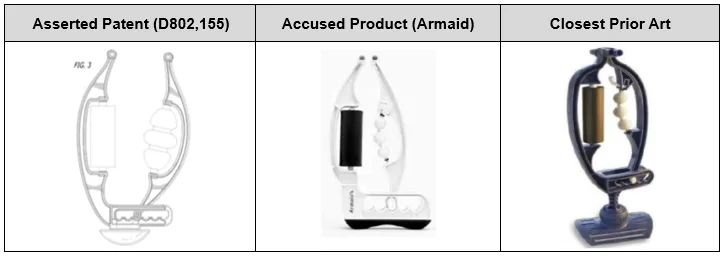
Under Egyptian Goddess, Inc. v. Swisa, Inc., 543 F.3d 665, 670 (Fed. Cir. 2008), design patent infringement turns on the ordinary observer test: whether an ordinary observer, giving the attention a purchaser usually gives, would find the accused design substantially the same as the patented design such that they would be deceived into buying one believing it to be the other. The infringement test requires no showing of actual confusion, and thus no costly consumer survey—a meaningful advantage over trade dress litigation. However, earlier designs (“the prior art”) frame how an ordinary observer would perceive the similarities and differences between the accused and patented designs, turning the analysis into a three-way comparison that includes the closest prior art. In a field crowded with prior art, even minor differences can carry outsized weight in the infringement comparison.
Ornamentality vs. Functionality — A Mutual Battleground
Functionality is a limiting doctrine in both design patent and trade dress law. A design patent can be invalidated if it is determined that its appearance is dictated primarily by function rather than ornamentation. Courts will also exclude functional aspects of a design before conducting an infringement comparison, which can tip the outcome: the fewer ornamental elements left in play, the easier it is to argue the accused design is meaningfully different. This effect, and the three-way comparison described above, is demonstrated by the Federal Circuit’s recent decision in Range of Motion Prods., LLC v. Armaid Company Inc., Case No. 23-2427 (Fed. Cir. Feb. 2, 2026), Slip Op. at 14. The decision affirmed the district court’s exclusion of clam-shaped roller arms when constructing the scope of the asserted patent—a significant aspect in the overall similarity of the designs—and the subsequent grant of summary judgment of non-infringement.
If you read Part 2 of our Brand Protection Toolkit to Combat Dupes, this treatment of functionality will feel familiar. In the context of trade dress, a product feature is functional if it is essential to the product’s use or purpose, or if an exclusive right to it would significantly disadvantage competitors. Dupe makers, whether defending themselves in design patent or trade dress litigation, can attempt to avoid liability by arguing that design aspects are functional and should be excluded from the infringement consideration.
The Remedy that Changes the Calculus: Total Profit Disgorgement
A key driver of growing investment in design patents is the powerful infringement remedy they can provide. Under 35 U.S.C. § 289, an infringer can be liable for its entire profit on the infringing article, not merely the profit attributable to the patented feature—a recovery available under no other form of intellectual property. This advantage became unmistakable in Samsung Elecs. Co. v. Apple Inc., 580 U.S. 53 (2016), where a jury awarded Apple $399 million in damages, representing Samsung’s entire profit on phones that infringed Apple’s design patents on the iPhone’s rounded rectangular face and icon grid. The signal to the market was clear: design patents can create enormous exposure, and would-be dupe makers should think twice.
Case Studies
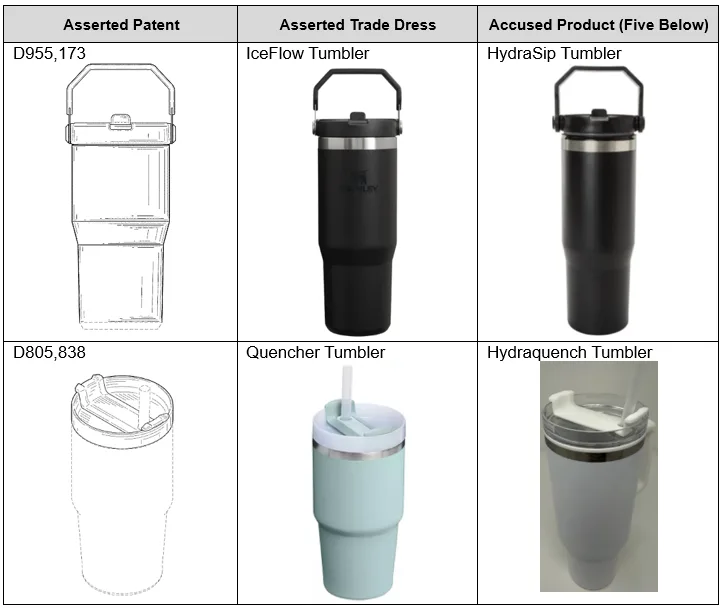
Pacific Market International, LLC v. Five Below, Inc., 3:25-cv-09604, (N.D. Cal., filed Nov. 6, 2025) demonstrates the strategy of stacking design patent and trade dress rights. PMI asserts trade dress in its IceFlow and Quencher tumblers also alleges infringement of two design patents, claiming that Five Below’s Hydraquench and HydraSip products are “substantially the same” as the patented designs when viewed side by side. By pleading design patent infringement alongside trade dress, PMI forces Five Below to defend on multiple fronts at once: even if the dupe maker defeats the trade dress claim on functionality or secondary-meaning grounds, the design patents remain a separate basis for liability that requires no proof of consumer confusion.
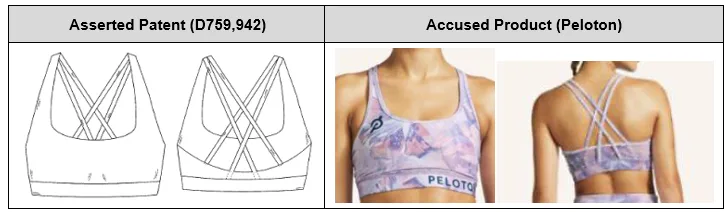
Lululemon Athletica Canada, Inc. v. Peloton Interactive, Inc., 2:21-cv-09252, (C.D. Cal., filed Nov. 29, 2021) shows the deterrent power of design patents even without a litigated verdict. After Peloton ended its co-branding agreement with Lululemon and launched its own apparel line in 2021, Lululemon accused it of selling “knock-offs” that infringed six design patents covering bras and leggings. Rather than litigate to judgment, the parties settled in September 2022, with Peloton agreeing to phase out the specific designs Lululemon had identified. For brand owners weighing enforcement, this case signals that a design patent portfolio can drive a favorable resolution without the cost, delay, and risk of trial.
Design Patents vs. Trade Dress: A Strategic Comparison
While design patents and trade dress can confer overlapping rights, the paths to obtaining and enforcing those rights differ significantly. The chart below highlights several key distinctions that brand owners should consider when developing a protection strategy that aligns with their product lifecycle, competitive landscape, and enforcement objectives.
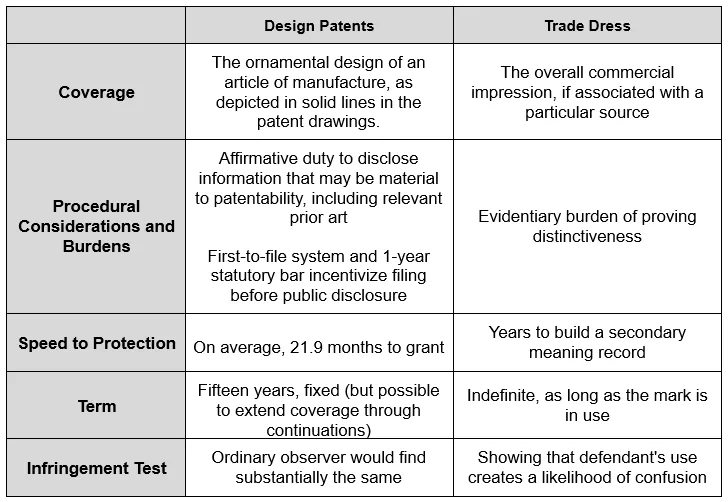
The distinctions outlined above illustrate why design patents confer valuable rights as markets become saturated with dupes. While trade dress offers potentially perpetual protection for designs that acquire source-identifying significance over time, design patents can provide relatively rapid protection without requiring a showing of secondary meaning or actual consumer confusion to enforce. In concert, the two rights can safeguard both the immediate and long-term value of a product’s visual identity, helping brand owners set trends without surrendering them to imitators.
Next in the series: Part 4 – When Fast Fashion Meets Copyright Law: Lessons from Brandy Melville v. Shein
This article is the third installment in our A Brand Protection Toolkit to Combat Dupes series.
Related Industries
Related Services
Receive insights from the most respected practitioners of IP law, straight to your inbox.
Subscribe for Updates