Imagine you text your husband while he’s running errands: “I ran out of mascara, can you stop at Ulta and get me new one? It’s Roller Lash, with the pink top and the black tube.” He finds one, and it looks like the mascara he’s seen you apply each morning. But did he come home with the Benefit Roller Lash, or e.l.f. Lash ‘N Roll?
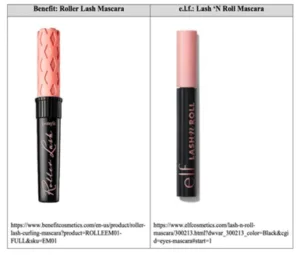
Benefit Cosmetics LLC v. e.l.f. Cosmetics, Inc., No. 3:23-cv-00734-RS (N.D. Cal. Feb. 24, 2023).
That all-too-common scenario cuts to the heart of trade dress law, and why it matters in the dupe era. Dupe makers have become sophisticated and avoid using confusingly similar word marks and logos. But a brand’s identity isn’t just its name—for many products it is the color, the shape, the overall look that consumers recognize on a shelf or in a cart. Trade dress protects that identity, and understanding how it works is essential for any brand trying to stay ahead of the dupe market.
When a dupe maker avoids a brand’s word mark or logo, it reduces the risk of a traditional trademark infringement claim. But trade dress operates differently. Rather than protecting a name or symbol, trade dress protects the overall commercial impression of a product – its appearance, packaging, color, shape, and design – to the extent those elements identify the product’s source in consumers’ minds. A dupe maker can steer clear of every logo and still walk straight into a trade dress claim.
Distinctiveness and Non-Functionality Are Where Trade Dress Claims in Dupe Cases Are Won and Lost
For trade dress to be protectable, it must be (1) distinctive and (2) non-functional. Both issues become battlegrounds in dupe litigation.
The first factor, distinctiveness, means consumers associate the claimed trade dress with a particular source. For packaging, trade dress can be inherently distinctive. For product configuration, the bar is higher: the design itself must have acquired secondary meaning through exposure and use over time. This is why brands that invest in building consistent visual recognition are better positioned than those that don’t.
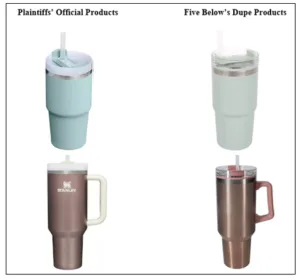
The second factor, non-functionality, is where dupe makers most often push back. A product feature is functional if it is essential to the product’s use or purpose, or if exclusive protection of it would put competitors at a significant disadvantage. In Pacific Market International, LLC v. Five Below, Inc., 3:25-cv-09604, (N.D. Cal., filed Nov. 6, 2025), the maker of the Stanley tumbler alleges that Five Below’s dupe drinkware copies the distinctive trade dress of its Quencher and IceFlow lines. Five Below’s response goes straight for the functionality defense, arguing that the handle’s design is ergonomic and the lid mechanism is splash-resistant, which are functional choices, not ornamental ones. The case is still pending, but it illustrates how dupe makers use the functionality doctrine to reframe copied design elements as engineering decisions rather than brand identifiers.
How Dupe Makers Exploit the Gaps — and Why It Doesn’t Always Work
The most common strategy by dupe makers is prominent house branding, displaying their own name and logo clearly on the product, on the theory that an informed consumer will know they are not buying the original and thus confusion is unlikely. This can help, but it is not a guaranteed defense. Courts look at the overall commercial impression a product makes, not just whether a label is present.
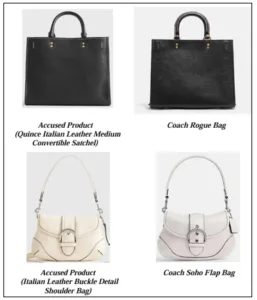
Three recent cases illustrate what trade dress claims look like in practice. In Tapestry, Inc. v. Quince, No. 3:25-cv-02902 (N.D. Cal., filed Apr. 4, 2025), Coach identified a combination of non-functional design features of its handbags — silhouette, stitching detail, and hardware placement — that it argued consumers have come to associate specifically with its brand. The case was dismissed without prejudice by joint stipulation in June 2026 without a ruling on the merits, but it reflects a broader push by brands to use trade dress claims to challenge look-alike products even where no logo has been copied.
In J.M. Smucker Company v. Trader Joe’s Company, No. 5:25-cv-02181 (N.D. Ohio, filed Oct. 13, 2025), the maker of the iconic Uncrustables crustless peanut butter and jelly sandwich alleges that Trader Joe’s copycat product mimics its distinctive packaging, including the round sealed shape with crimped edges, a bite mark illustration showing the filling, and blue-toned packaging. Smucker’s makes clear it is not objecting to a competitor selling a similar sandwich, only to the imitation of the specific visual identity that tells consumers who made it. This case remains pending, with Trader Joe’s motion to dismiss fully briefed and awaiting the court’s decision.
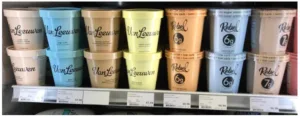
A third case shows what happens when a trade dress dispute goes the distance. In Van Leeuwen Ice Cream LLC v. Rebel Creamery LLC, No. 21-CV-2356 (E.D.N.Y. July 16, 2026), a federal court held after a full bench trial that Rebel’s “keto” ice cream pints infringed and diluted Van Leeuwen’s pastel, monochrome, black-script packaging, despite Rebel’s use of its own house brand name and keto-specific labeling (net carb counts, “keto, full fat, lactose free” language). The court found that those additional elements on Rebel’s packaging did not dispel confusion, particularly given the products’ proximity on grocery shelves and a 34.3% net confusion rate in Van Leeuwen’s consumer survey. The result was a permanent injunction requiring Rebel to redesign its packaging, plus an accounting of profits totaling nearly $24 million. The case is a reminder that house branding and category-specific add-ons are not a safe harbor against a well-documented trade dress claim.
What Brands Should Be Doing Now
Trade dress law rewards preparation and consistency. Brands that can point to a consistent, well-documented set of design elements, and show through evidence how those elements have been used and promoted over time, are in a strong position when litigation becomes necessary. The USPTO and courts particularly like “look for” advertising, that essentially explains to consumers how to differentiate the brand’s products by design and other visual elements. Building the secondary meaning evidentiary record through consumer surveys, sales figures, and marketing spend should happen during the normal course of building the brand, not as a knee-jerk response to a lawsuit.
Registration is also worth evaluating, but carefully. Trade dress can be registered as a trademark, providing a presumption of validity and access to enhanced remedies that unregistered trade dress does not enjoy. At the same time, brands should think twice before filing if there is a meaningful risk that the USPTO might find the trade dress unregistrable. An adverse determination on the record that the claimed trade dress is functional or lacks distinctiveness (or both) can be used against the brand in subsequent litigation, potentially doing more harm than good. The decision whether to seek registration is itself a strategic one that deserves careful analysis.
As for the mascara that started this article — a California federal court ruled in December 2024 that e.l.f.’s Lash ‘N Roll did not infringe Benefit’s trade dress, finding no likelihood of confusion despite acknowledging the commercial strength of Benefit’s packaging. The court pointed to differences in how the products are sold and marketed, and found that e.l.f. had not intended to deceive consumers about the product’s origins. It is a useful reminder that trade dress protection and trade dress infringement are two different questions, and that winning on one does not guarantee winning on the other.
Coming Up Next
Trade dress is one layer of protection, but it rarely stands alone. In the next installment of the series, we will turn to design patents, which protect ornamental product features for fifteen years and offer some of the most powerful remedies available in dupe litigation, including total profit disgorgement. Savvy brands are increasingly pursuing trade dress and design patent claims in tandem, and understanding how those doctrines interact is essential to building an effective enforcement strategy.
This article is the second installment in our A Brand Protection Toolkit to Combat Dupes series.
Related Services
Receive insights from the most respected practitioners of IP law, straight to your inbox.
Subscribe for Updates