Part 1 of a Ten-Part Series: Intellectual Property as a Value Driver and Risk Factor in Life Sciences Venture Investment
A freedom-to-operate (FTO) analysis is a crucial component of investment due diligence in the life sciences, as it allows investors to assess the company’s ability to use its product without significant risk of litigation. Most experienced life sciences investors understand the basic structure of freedom-to-operate analysis. What is less consistently applied is the discipline of treating FTO not as a legal sign-off to be obtained before closing, but as an active investment variable – one that should shape deal terms, inform prosecution strategy, and drive post-investment competitive monitoring. A decision-making process that rigorously incorporates FTO analysis into the diligence framework, rather than treating it as a supplemental consideration, is better positioned to align transaction value with risk.
This article focuses on this diligence framework: not the mechanics of what FTO is, but the more demanding questions of how it should be scoped, what its structural limitations are in a life sciences diligence context, and how its risk profile shifts across financing stages in ways that a checklist approach consistently fails to capture.
The Scoping Problem
The most consequential FTO failures in venture-stage life sciences investment are rarely the result of no analysis having been performed. These failures result from analyses that were competently executed within an insufficiently defined scope. An FTO opinion is only as reliable as the product definition and the technology perimeter it was asked to assess, and in early-stage companies, both of those inputs are frequently in flux.
A common pattern: a company enters Series A diligence with an FTO opinion prepared 18 months earlier by its own counsel, against a lead compound or platform configuration that has since been materially modified. The opinion addresses a product that no longer exists in that precise form. The company and its counsel may reasonably believe the opinion remains directionally valid, and they may be right. But the opinion does not speak to the current product, and the investor has no independent basis for that judgment unless independent counsel conducts a gap analysis.
A related scoping issue arises in platform technology companies, where the FTO opinion addresses the foundational platform rather than the assets or pipeline products that the company is pursuing. This is particularly common in RNA therapeutics, gene editing, and diagnostics, where the gap between the founding scientific concept and the commercial product can be substantial, and where the relevant blocking patents may operate at the application layer rather than the platform layer.
Sophisticated diligence requires investors to pressure-test scope before evaluating conclusions. The right questions are:
- What product, formulation, construct, modality, indication, or method of use was actually analyzed?
- Was the analysis directed to the company’s current product, or to an earlier version?
- What claim language was mapped, and were the relevant claims pending, issued, expired, or jurisdiction-specific?
- Were continuation applications, recently issued claims, and newly published PCT applications captured?
- Was the analysis updated after any material design change, new indication, manufacturing change, or geographic expansion?
An opinion that cannot answer these questions is not a reliable diligence input, regardless of how favorable its conclusion is.
Why Independent Review Is Not Optional
Company-sponsored FTO opinions are neither impartial nor cost-effective for a company actively fundraising. Opinions that are produced by counsel who are simultaneously prosecuting a company’s patent portfolio tend to follow a commercial narrative, rather than surfacing every meaningful risk. Company counsel are embedded in a relationship which favors a positive investment outcome. This issue is not attorney competence or good faith and such opinions are not necessarily dishonest – rather, the issue is institutional context. This structural tension in company-sponsored FTO opinions is well understood in the IP community but tends to be underweighted in investment diligence.
These potential issues may arise in the following contexts:
- Different incentives: company counsel is usually supporting a financing or transaction narrative.
- Different search framing: prosecution counsel may search from the company’s technical perspective rather than a competitor’s enforcement perspective.
- Different risk tolerance: company counsel may characterize marginal risks differently than investor counsel.
- Different commercial lens: company counsel may focus on claim mapping, while investor counsel must also test enforcement behavior, licensing leverage, and exit impact.
The more subtle problem with company-sponsored FTO opinions is search calibration. An FTO search conducted by prosecution counsel who are deeply familiar with the company’s own technology tends to be anchored on that technology’s conceptual framing. Alternative claim constructions, analogous mechanism patents, and method-of-treatment claims from adjacent therapeutic areas may be systematically underweighted – not because counsel is being negligent, but because the search architecture reflects the company’s own view of its technology rather than a court’s or a competitor’s.
Independent review adds value precisely because it imports a different search architecture and a different risk tolerance. An independent reviewer with no interest in the company’s success will search more broadly, characterize scope more conservatively, and surface the outlier risks that a company-sponsored opinion has structural incentives to minimize. At Series A and beyond, this is not a luxury – it is the difference between understanding your actual risk exposure and understanding the most favorable characterization of your risk exposure.
Finally, a common misconception many startups have is they must perform some form of FTO analysis themselves to engage in investor diligence. Fundamentally, an FTO analysis should dovetail with investor diligence, not a company’s diligence of itself, for the most efficient path to fundraising. Furthermore, a useful FTO package can be costly for a seed-stage company, and as discussed above, can miss the mark if not performed by independent counsel in view of a broader investment thesis.
The practical implementation does not require commissioning a complete de novo FTO opinion in every case, which would be impractical for earlier-stage investments or short diligence timelines. A targeted independent review, focused on the two or three patent families that the company’s own counsel identified as the most significant third-party risks, provides substantial incremental assurance without the cost and time burden of a full re-analysis. The key is that the review is genuinely independent, that it is scoped to the current product, and that it addresses the commercial behavior of the relevant patent holders, not just the technical claim mapping.
The Commercial Behavior Dimension
Patent claim analysis tells you what a patent covers. It does not tell you what the patent holder will do with it, and in a venture investment context, the latter question is often more commercially material than the former.
A blocking patent held by a large pharmaceutical company that has historically cross-licensed in the relevant space presents a categorically different risk than the same patent held by a non-practicing entity with an active enforcement program, or by a direct competitor with the strategic motivation to use its IP position to foreclose a market entrant. FTO opinions routinely reach the same technical conclusion – potential infringement risk – across these three scenarios, but the actual investment implications are entirely different.
Investors should expect diligence to address the enforcement history and licensing behavior of key patent holders as a standard component of FTO analysis. This means asking whether the relevant patent holders have asserted these patents in litigation or inter partes review (IPR) proceedings, whether they have publicly stated licensing positions, and whether portfolio companies in adjacent spaces have navigated the same landscape successfully. In crowded therapeutic areas such as oncology, immuno-oncology, and GLP-1-related metabolic disease, the major patent families are well-known, and there is often substantial public record of how the relevant holders behave.
Commercial behavior diligence should test:
- Has the patent holder asserted the relevant patents in litigation, IPR, opposition, or reexamination proceedings?
- Does the patent holder have a history of licensing in the relevant therapeutic or technology area?
- Is the patent holder a direct competitor, strategic partner, non-practicing entity, university, platform company, or large pharmaceutical company?
- Has the patent holder taken public positions regarding exclusivity, licensing, or platform access?
- Are there examples of similarly situated companies obtaining licenses, designing around, or challenging the relevant rights?
- Does the company have any counter-position, such as blocking claims, platform improvements, or commercial leverage?
Equally important is understanding the economic leverage dynamics. A company seeking a license from a patent holder whose technology is alleged to be blocking has fundamentally weaker negotiating leverage than one approaching the same conversation from a position of mutual blocking, where the company holds patents that the licensor needs to operate in an adjacent space. Investors who understand the cross-blocking topology of a patent landscape are better positioned to assess the realistic terms on which a licensing resolution could be achieved, which directly affects financial modeling and exit assumptions.
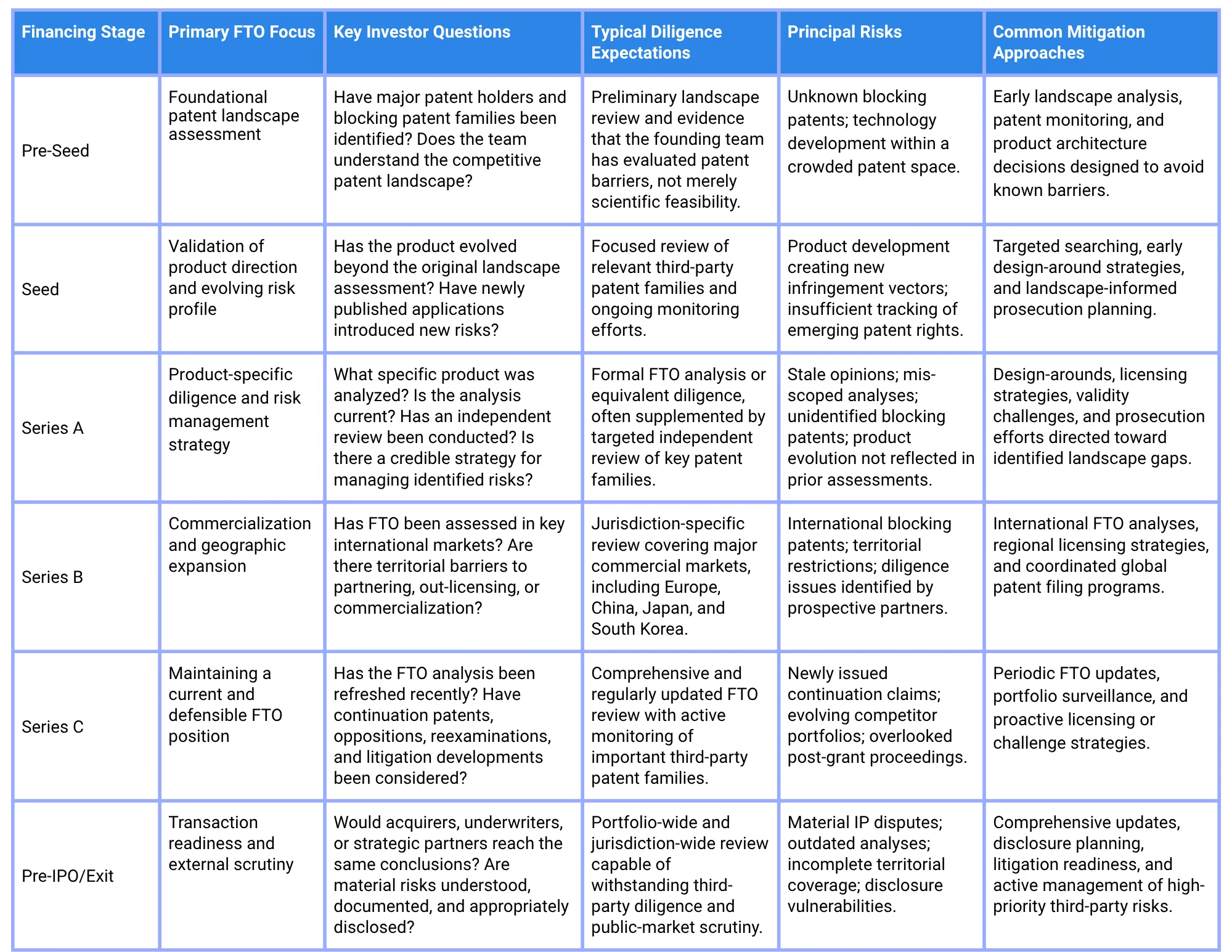
Stage-Specific Risk Calibration
FTO risk does not scale linearly with financing stage, it shifts in character. At pre-seed and seed, the primary FTO risk is foundational: has the team identified the major blocking families in the space, and is the company’s product concept architecturally positioned to navigate them? This does not require a formal opinion, but it does require evidence that the founding team has engaged seriously with the competitive patent landscape, not just with the scientific literature.
At Series A, FTO becomes a primary diligence item. The product is defined with sufficient specificity to support a meaningful analysis, the company is deploying significant capital against a specific commercial trajectory, and the cost of discovering a blocking patent post-investment is already substantial. The question at this stage is not just whether a risk exists but whether the company has a credible strategy for managing it – whether through prosecution, design-around, licensing, or a validity challenge thesis.
Series B introduces a different dimension: international market exposure. A company that has secured U.S. FTO but has not assessed its position in the EU, China, Japan, and South Korea has an incomplete picture of its commercial optionality. This matters not only for direct commercialization but for partnership and out-licensing transactions, where a counterparty conducting their own diligence will surface international blocking risks that the company has not addressed. An international FTO gap discovered during Series B diligence by a prospective partner is a negotiating liability; discovered by the investor, it is a pricing opportunity.
At Series C and beyond, pre-acquisition, or pre-IPO, FTO analysis must be current, comprehensive, and defensible to external scrutiny. Companies at this stage are frequently in active discussions with strategic partners, and the FTO landscape will be independently assessed by counterparty counsel. An opinion that was not updated to reflect continuation claims issued in the prior twelve months, or that does not address recent re-examination outcomes affecting key patents in the space, is a vulnerability. Investors at this stage should verify that the company’s FTO analysis has been refreshed within the prior year and covers the full commercial footprint.
FTO as a Prosecution Feedback Loop
One dimension of FTO analysis that sophisticated investors should actively promote in their portfolio companies is its use as an input to prosecution strategy, not just as a risk management exercise. A thorough FTO analysis identifies claim scope that competitors have not captured, design-around approaches that could themselves be patented, and continuation claim strategies that could create blocking positions against identified third-party patents.
This is most valuable at Series A and B, when the company’s prosecution program is still sufficiently open to incorporate strategic adjustments. A company that has conducted genuine landscape analysis and is actively prosecuting into identified gaps, rather than merely prosecuting the technology it invented, has a materially stronger IP position than one that has filed without reference to the competitive landscape. Investors who push portfolio companies toward this discipline are creating value, not just managing risk.
The feedback loop also operates defensively. Understanding which of a company’s own pending claims most directly implicate third-party commercial interests helps prioritize prosecution resources and identify the claims that are most likely to attract validity challenges. A company that enters a partnership or licensing discussion with a clear understanding of which of its own claims are most commercially threatening to the counterparty is in a fundamentally better negotiating position.
Conclusion
The investors who consistently integrate sophisticated FTO analysis into life sciences investment decisions are positioned to make stronger, better-priced, and future-proof investments. They are also positioned to get deeper value out of the analyses they receive. Is the scope current and accurately defined? Has it been independently reviewed for the most significant risks? Does it address commercial behavior, not just claim mapping? Is it integrated into prosecution strategy rather than siloed as a legal deliverable?
An FTO analysis that answers those questions well is not a transaction cost. It is investment intelligence, and in a sector where exclusivity is the primary value driver, getting that intelligence right is among the most consequential things a diligence process can accomplish.
Table 1: FTO Risk Calibration Across the Life Sciences Financing Lifecycle
Key Insight: Freedom-to-operate risk does not scale linearly with financing stage. Rather, the character of the risk evolves as a company progresses from scientific concept to commercial enterprise. Effective diligence therefore requires stage-specific FTO objectives and diligence standards.
Click the table to download.
Related Industries
Related Services
Receive insights from the most respected practitioners of IP law, straight to your inbox.
Subscribe for Updates