The distinction between a company name (“trade name”) and a trademark is a foundational concept in trademark law – but one that still manages to catch unknowing brand owners by surprise, as the U.S. Patent and Trademark Office’s Trademark Trial and Appeal Board (“TTAB”) recently reminded in its decision In re Maple Leaf Cheesemakers, Inc., Serial No. 88663903 (TTAB Apr. 8, 2026). In short, a trade name identifies the business entity, while a trademark is the name of a product or service.
In an efficient 5½ page decision, the TTAB affirmed the Examining Attorney’s “failure-to-function” refusal to register the word mark MAPLE LEAF CHEESE CO‑OP for “cheese” in Class 29, because the filed specimen (depicted below) showed use of the wording “Maple Leaf Cheese Co-op” only as a trade name, and not as a trademark.
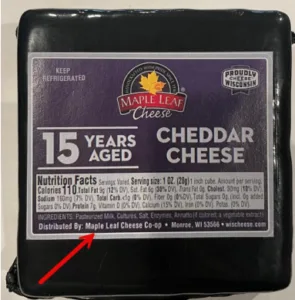
As indicated above, Maple Leaf Cheesemakers’ specimen of use included the wording “Maple Leaf Cheese Co-op” after the wording “Distributed by,” and followed by the company’s location and website information – with the informational wording largely in the same font size, style, and color as the company name. The label also included a stylized company logo with the wording “MAPLE LEAF Cheese” (without the applied-for word “Co-Op”) and a maple leaf design at the top.
Viewing the label as a whole, the TTAB agreed with the Examining Attorney that consumers will perceive MAPLE LEAF CHEESE CO‑OP as identifying the distributor of the goods (i.e., as a trade name), and not as identifying the source of the cheese itself (i.e., as a trademark).
Although Maple Leaf Cheesemakers argued that the refusal was invalid because its legal business name is not “Maple Leaf Cheese Co-op,” the Board maintained that the manner of use determines consumer perception, not corporate formalities. Here, the claimed mark was buried in a block of informational text, and wasn’t set apart by size, stylization, a logo/design, or other cues that typically signal a trademark.
The takeaway from this decision is straightforward, but significant – context matters! If a company name or other source-identifier is used only in combination with informational text such as address blocks, legal notices, “distributed by” statements, and the like, consumers are likely to view it as a trade name. Here are some practical tips to strengthen trademark use and avoid a similar refusal:
- Place the mark where consumers expect to find a brand name (often on the front label), not only in a contact or distribution information block
- Make it visually distinct – larger size, different font, stylization, a logo/design, a ™ trademark symbol, and/or separation from surrounding text
- Avoid showing trademark wording only after information designations like, “Distributed by,” “Manufactured for,” “Packed by,” etc.
- If you use the same words as both a company name and a brand (i.e., a “house mark,” which is often a shortened version of the company/trade name without the entity designation), show clear brand use consistently on or in connection with the goods/services
As this brief but helpful decision makes clear, even small tweaks in placement and design can bridge the gap between unregistrable trade name use and trademark protection.
Related Industries
Related Services
Receive insights from the most respected practitioners of IP law, straight to your inbox.
Subscribe for Updates