Summer Associates Tash Medde-Witage and Carson Story contributed to this article.
Introduction
Graphical User Interfaces (GUIs) – the digital displays people interact with daily – are commonplace in today’s world. But they are becoming increasingly detached from the traditional smartphone, tablet, and computer screens most people are used to. Many modern products present GUIs through augmented reality, virtual reality, or projected interfaces.
As technology has evolved to integrate GUIs into more aspects of everyday life, design patent practice – which historically developed around the assumption that a GUI would be displayed on conventional screens – has evolved to better protect these modern, screenless GUIs.
In March 2026, the USPTO issued supplemental guidance providing new examination examples for GUI-related design applications and withdrew portions of prior guidance that reflected outdated practices. This article examines how GUI protection was approached under previous practice, what the USPTO has changed, and the practical implications for applicants looking to protect their GUIs with design patents.
GUI Protection Before the New Guidelines
As the name suggests, design patents protect the unique appearance of something. Before the USPTO’s supplemental guidance, a GUI design had to be claimed as a display screen, and the drawings depicting the design had to at least nominally show the display screen.
The traditional framework considered display screens as articles of manufacture and required the title and claim of a design patent application to recite a design for a “computer screen,” “display panel,” or “display screen.” Since GUI designers design GUIs, not display screens, this framework was always a bit of an odd fit, and chafed against the growth and innovation of GUI design as it permeated through all types of industries with a digital presence. But it really broke down in the face of recent evolutions in technology, which present GUIs without even using a traditional display screen.
Augmented reality (AR), virtual reality (VR), and projected interface technology generally did not fit within the concept of a GUI displayed on a conventional computer screen. As digital experiences increasingly moved beyond traditional displays, a better solution for protecting designs for these emerging technologies was needed.
Recognizing this need, the USPTO issued “Supplemental Guidance for Examination of Design Patent Applications Related to Computer-Generated Interfaces and Icons” to clarify and modernize the USPTO’s approach to subject matter and disclosure requirements for computer-generated interfaces, particularly those presented in environments such as AR, VR, and projected interfaces.
What Has Changed With the New Guidelines?
The new guidelines have changed GUI practice in two major ways: (1) the manner in which GUI designs may be claimed, and (2) the depiction of the display screen in design patent drawings.
First, the guidance shifts away from requiring GUI designs to be claimed as part of a display screen and instead permits claims directed to the graphical user interface itself. An applicant can now claim a design for “a graphical user interface for a display screen” or a design for “an icon for a computer system” rather than needing to claim a the display screen as the subject of the design.
Second, the guidance no longer requires that a display screen be depicted in the drawings, eliminating the need to show a broken-line boundary around a design in order to represent the display screen.
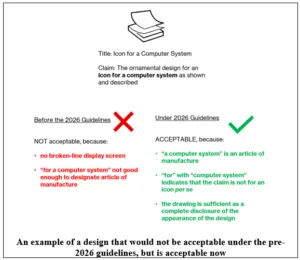
Importantly, both of these new changes are permissive, and add to the applicant’s flexibility in protecting their design in the way most appropriate to their situation. For example, there might still be instances where an applicant wants to claim their design as a display screen, or wants to include a broken-line boundary around it, in which case the applicant is still free to do so. This change transforms depicting and claiming a display screen from a requirement into a strategic drafting decision. The particular features of the design and the intended scope will help determine whether and when to use the old practices, and when the new ones will be more appropriate for the applicant’s goals.
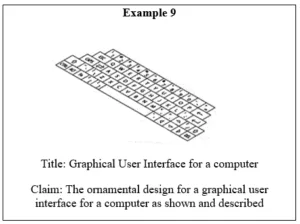
The guidance provides an example of a claimed “Graphical User Interface for a computer.” The design for Example 9 is presumed to be a projected design, where the source computer is projecting it onto a generic surface. Although no computer or display screen is shown in the drawing, the title and claim adequately identify the computer as the associated article of manufacture, demonstrating that a physical article of manufacture does not always need to be shown in the drawings.
Consistent with this approach, the guidance also provides examples of non-traditional display environments, including AR, VR, and projected interfaces. Examples include GUIs projected onto a vehicle windshield via a heads-up display, virtual control panels in a virtual reality environment, or control interfaces presented through augmented reality glasses.
Conclusion
Modern GUI design patent practice must continually adapt to accommodate ever-advancing technology. The USPTO is doing its part to keep pace, as are other patent offices around the world. Design patent practitioners are therefore also updating their strategic outlook and practices, and advocating for additional changes where needed. This won’t be the last time that design practice changes, and its dynamism is part of what keeps design protection at the forefront of a well-developed strategy for IP protection across a wide range of industries.
This article is the second installment in the Protecting Software with GUI Design Patents series.
Related Services
Receive insights from the most respected practitioners of IP law, straight to your inbox.
Subscribe for Updates