As covered in our prior alert, the USPTO’s new pre-order paper procedure allows a patent owner to file a 30-page paper within 30 days after being served with an ex parte reexamination (EPR) request filed with the Central Reexamination Unit (CRU). In that paper, a patent owner may only raise arguments relating to the requestor’s asserted substantial new question (SNQ), but not 35 U.S.C. §325(d) arguments (which may be argued in a different paper). Notably, the requester does not have an automatic right to reply to the paper. Instead, under certain circumstances, the requestor may pay a fee and file a petition along with a 10-page reply within 15 days of being served with the pre-order paper. This new pre-order paper procedure arrives to a shifting landscape.
Suggestions To Fix Potential Issues With Current Procedure
Patent Owner’s must understand and keep in mind that the 30-day time limit for filing any pre-order paper begins on the date the patent owner is “served” with a reexamination request, as provided under 37 C.F.R. § 1.248. Notably, under Rule 1.248(a)(4), service may, and usually does, occur by first class mail—but not by FedEx or email, which are not mentioned in Rule 1.248. Thus, the date of service is the date of mailing. In other words, the date of service is not the date a patent owner will actually know about or receive any first-class mail serviced request.
In fact, the time limit is only 30 days on paper for at least two reasons, depending on how a patent owner may learn about an EPR request. First, the USPTO takes between 2-10 days to make a complete EPR request filing available on Patent Center and to link the request to the relevant patent and its underlying Patent Center prosecution file. Second, first class mail can take 3-7 days to arrive to a patent owner’s representative (as identified by Patent Center). So, if a patent owner is not manually checking every reexamination filing every day on Patent Center, it is very likely that they will have less, and potentially significantly less, than the 30 days to prepare and file a pre-order paper.
Similarly, when circumstances allow, a requester’s 10-page reply may end up being delayed if the pre-order paper is not immediately available on Patent Center and the requester does not receive the paper via first class mail for several days after service. In fact, in certain circumstances, it could be the case that what the Patent Owner filed will not be available to the requester until after the 15-day petition period has already expired.
Based on these issues, the authors suggest the USPTO consider (1) changing the start date for determining the 30-day window for filing a pre-order paper to be based on the mail date of the Notice of Reexamination by the USPTO, (2) changing the start date for determining the 15-day window for filing a fee, petition, and reply to be based on the posting date of the patent owner pre-order paper to Patent Center, and/or (3) require FedEx overnight service and/or email service of all papers to avoid prejudice to the parties.
Practitioners should think about suggesting the Director make these changes.
Statistical View of IPRs and Ex Parte Reexaminations
With discretionary denial practice reshaping the availability of inter partes review (IPR) (which replaced inter partes reexamination in 2012), ex parte reexamination is finding a resurgence. The graph below demonstrates the interplay of IPRs and EPRs through several years, which shows the number of reexamination filings now outpacing IPR filings. April 2026 saw the lowest monthly total of IPR petitions since 2012 with only 15 IPR petitions (and 5 post-grant review (PGR) petitions—not shown) filed with the Patent Trial and Appeal Board (PTAB).
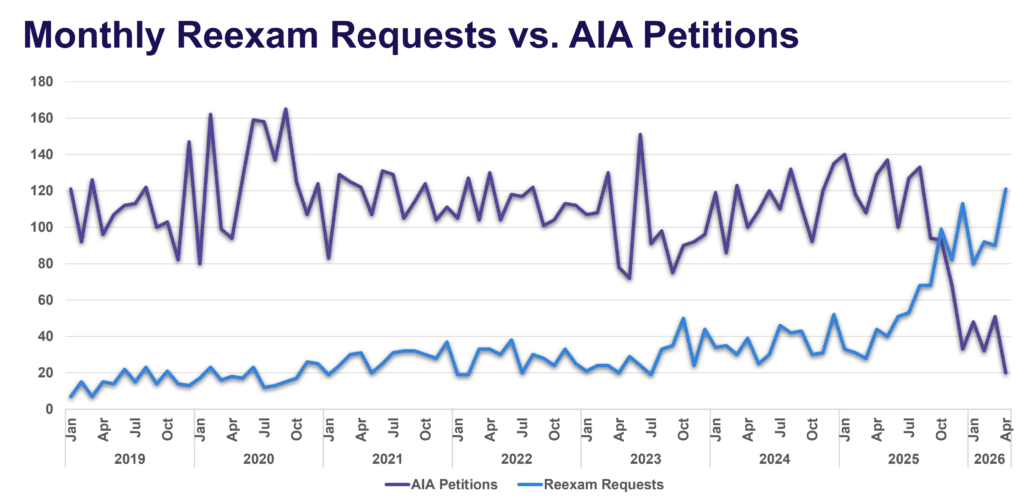
As alluded to in USPTO’s April 1, 2026, notice introducing the new procedure, the pre-order paper in EPR proceedings allows patent owners to inject advocacy before the Office decides whether to grant a request for reexamination. This meaningfully alters considerations for both requesters and patent owners.
For Requesters
Avoid Easy Outs. Threshold issues in an EPR request now have a procedural outlet that can be used by patent owners to quickly defuse reexamination. The pre-order paper lets the patent owner pick off requests that hand it a clean exit, potentially without having to engage with the merits at all. Requesters should take care to avoid these easy outs and having to expend more resources to prepare and file corrected requests.
- Apply and explain correct claim construction under the proper standard. Most reexaminations apply the broadest reasonable interpretation standard, but when a patent expires during reexamination, the ordinary and customary meaning standard applies instead. A requester that builds its SNQ arguments on the wrong claim construction and/or standard hands the patent owner a threshold argument that the pre-order paper can now raise immediately, before the proceeding ever begins.
- Verify 35 U.S.C. § 315(e)/ § 325(e)(1) certification and/or any statement needed with the filing of an anonymous EPR request. Challengers shifting from an AIA proceeding should confirm they are not carrying § 315(e)(1) or § 325(e)(1) estoppel into the reexamination. Along these lines, requesters must provide all necessary certifications and statements to the Office accordingly. See 37 C.F.R. §1.510(b)(6); Feb. 4, 2026, Notice, “Filing Anonymous Requests for Ex Parte Reexamination Directed to Previously-Challenged Patents. Defective certifications, for example, have resulted in the reexamination order being vacated. The pre-order paper is now the patent owner’s first procedural opportunity to flag such defects.
Build for Rebuttal. A reexamination request carries no page limit and can raise dozens of SNQs, which is an advantage that, under this new procedure, bears directly on the patent owner’s ability to prepare a meaningful pre-order paper in response. A requester that structures its request to raise as many legitimate SNQs as possible, supported by detailed claim charts, evidence, and expert analysis, forces the patent owner into a challenging triage: 30 pages and 30 days to address comprehensive, wide-ranging SNQs.
Building maximalist requests comes with its own considerations, however. An EPR request built to overwhelm a possible pre-order paper with legitimate SNQs demands commensurate investment with comprehensive claim charts, rigorous expert analysis, sufficient evidence, and airtight prior art mapping across every SNQ raised. A sprawling request that sacrifices quality for volume invites a different risk: that the CRU Examiner draws the same conclusions that PTAB has long drawn about unfocused AIA petitions. Unfocused AIA petitions, inadequately supported by sufficient arguments and evidence, have not historically fared well at the PTAB. While examiner-level adjudication at the CRU has been more forgiving of breadth in requests than panel-level review of petitions at the PTAB, the new pre-order paper gives the CRU a focused counter-narrative to weigh against a sprawling request. Whether the USPTO develops a similar instinct against volume-over-quality EPR requests at the CRU will materially affect how reexamination requests are drafted.
Finally, requesters should be aware of what it means to have no reply as of right. In IPR proceedings, a petition is usually crafted with the knowledge that a Patent Owner Preliminary Response (POPR) is likely to follow. Thus, experienced practitioners often build anticipatory arguments into an AIA petition. The same discipline could now apply in the EPR request context. An EPR request that cannot stand on its own against a well-prepared pre-order paper has vulnerabilities that the requester has no procedural right to cure. The new procedure permits a requester reply only to address misrepresentations of fact or law or arguments that “materially impede” the SNQ determination. The notice does not explicitly define that standard and so it remains a question how it will be interpreted. How liberally the CRU interprets that threshold is another variable worth watching as this procedure develops.
For Patent Owners
Patent owners face countervailing considerations for taking advantage of a meaningful opportunity to shape the narrative before an EPR begins. The threshold question is whether to file at all and potentially allow the requester another 15-page argument. In most cases, the answer will still likely be yes.
Be Ready to Respond to an EPR Request When Filing Complaint for Patent Infringement. Patent Owners need to be prepared for the short time period for filing a pre-order paper in response to an EPR request on the date they assert a patent. Reexamination proceedings move fast and leave little flexibility. Notably, the 30-day window runs from service of the request, not from when a patent owner’s EPR counsel is retained, conflicts are cleared, or before the full scope of the EPR request is understood. In practice, that 30-day window will be shorter than it looks. Accordingly, Patent Owners in active or imminent enforcement mode should have pre-order response capacity built into their enforcement plan in anticipation of reexamination.
Patent owners already have the ability to file a post-order patent owner statement under 37 C.F.R. § 1.535, but this paper triggers a requester reply and hands the challenger a second opportunity to attack. Unlike a post-order paper, the pre-order paper carries less risk because requesters have no reply as of right. But how much less risk is another open question given the uncertainty around how the “materially impede” standard will be interpreted. Depending on how the CRU interprets that threshold, the pre-order paper could function as an advantage for a carefully crafted submission (if the threshold is high), or it could effectively recreate the Rule 1.535 dynamic, giving the requester another bite at the apple (if the threshold is low). Patent owners should draft their pre-order paper accordingly with the awareness that a carelessly constructed paper may allow for a requester to have yet another opportunity to attack.
When/Should You Play the § 325(d) Card. Application of § 325(d) is a meaningful constraint on reexamination, if an EPR request relies on the same or substantially the same prior art or arguments previously presented to the Office, for example in a prior IPR. Under the new procedures, patent owners cannot raise § 325(d) arguments at the pre-order stage, even when those arguments are the strongest available. Instead, patent owners have turned to filing unauthorized petitions under Rule 181/182/183 as a way to raise this issue pre-grant. So, even under the new rules, a § 325(d) argument is not lost; it is still viable using unauthorized petitions practice before an EPR is ordered. Or patent owners can raise this issue in response to an Office Action.
Choose Your Arguments Carefully. Similar to everything else the patent owner says during prosecution before the Office, what goes into a pre-order paper will not stay there. Statements about claim scope, prior art distinctions, and technical characterizations become part of the intrinsic record, and can be used against the patent owner later, e.g., as it relates to estoppel. For instance, such statements will be available to defendants in district court infringement, validity, and claim construction arguments, to any petitioners building IPR and PGR petitions for patents in the same family, and to licensees looking to temper royalty demands. The discipline that experienced practitioners must bring to POPR drafting in AIA proceedings applies to pre-grant papers in EPR proceedings with similar force. Every word can be a potential concession.
Watching the Procedure Develop
The new pre-order paper procedure exists by waiver of the rules, not rulemaking. Thus, it could be modified or withdrawn in the future. Stakeholders should consider current strategy as provisional and be ready to adapt, as needed. Beyond that, even with the new procedure as it stands today, several variables remain unsettled: how CRU Examiners will weigh maximalist EPR requests against focused ones, how they will interpret “materially impedes,” and how much influence the new process will have on SNQ decisions. The pre-order paper procedure borrows a mechanism from the IPR playbook, but the reexamination context itself means that the reexam playbook is likely to diverge. The first group of pre-order papers and related SNQ decisions will start to reveal where.
As EPR requests have soared in response to new policies regarding IPR discretionary denials, some commentators have wondered whether the Office will address this surge at the CRU with similar rules and procedures as IPRs, for example, by changing reexaminations to a Director-only review system with single page decisions indicating whether to grant EPRs.
Related Services
Receive insights from the most respected practitioners of IP law, straight to your inbox.
Subscribe for Updates