Innovations in agriculture extend far beyond seeds and soil. Patented agricultural advances now include gene-edited crops, biofertilizers, precision harvesting equipment and new irrigation technologies. These advances help farmers and producers address urgent challenges — from climate variability to labor shortages — while also pushing the current boundaries of productivity and sustainability.
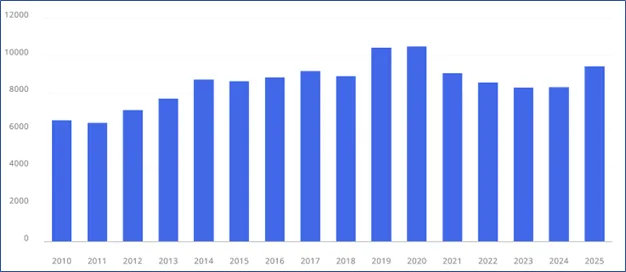
As agricultural innovations grow, so does the strategic importance of intellectual property, such as patents and trademarks. Patents are core business assets that attract investment, support partnerships and shape competition in the market. In fact, the total number of agricultural-related patents granted by the United States Patent and Trademark Office (USPTO) has slowly increased over the last 15 years, as shown in Figure 1.[1]
Three Avenues To Challenge a Competitor’s Agricultural Patents
To ensure freedom-to-operate, an agricultural company may challenge a patent held by a competitor to avoid paying licensing fees or to eliminate obstacles to entering the market created by the competitor’s patent.
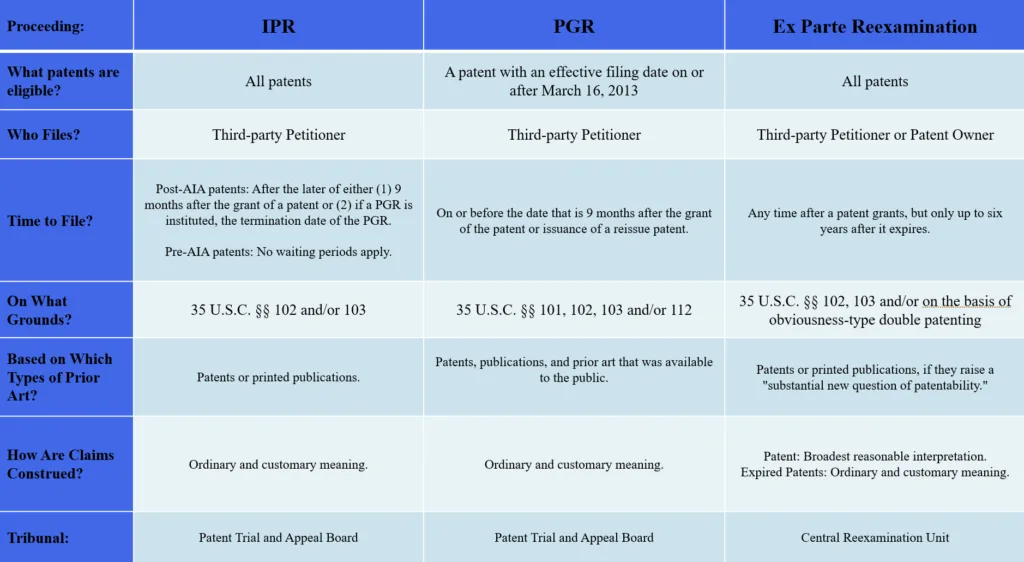
For many years, the only way to challenge the validity of a patent in the United States was through lengthy and expensive district court litigation. With the introduction of the Leahy-Smith America Invents Act (AIA) in 2011, inter partes review (IPR) and post-grant review (PGR) proceedings became alternative avenues to challenge the patentability of a patent.
The AIA established a first-inventor-to-file patent system that became effective on March 16, 2013. As such, patent applications filed before March 16, 2013, are considered “pre-AIA” and patent applications filed on or after March 16, 2013, are considered “post-AIA.” Notably, pre-AIA patents are not PGR eligible, but all patents are IPR eligible.
Furthermore, a third-party petitioner (competitor) or a patent owner can file an ex parte reexamination request asking the USPTO to review one or more claims in a granted patent, if a substantial new question of patentability is raised. A comparison of these three proceedings is illustrated in Figure 2.
Agricultural-Related Patent Proceedings by the Numbers
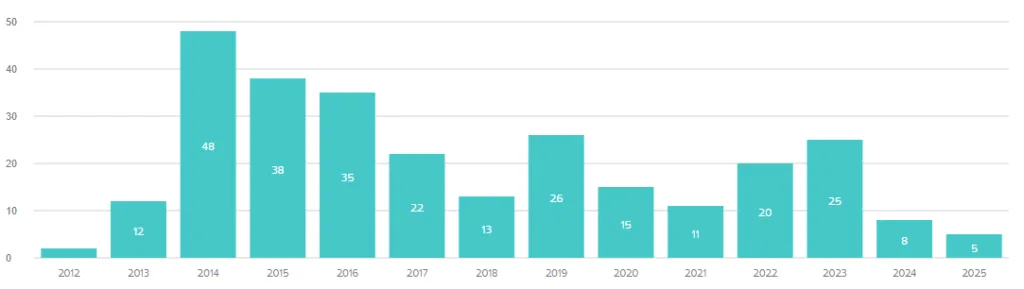
Although not as widely utilized as in other technology sectors, companies have petitioned the Patent Trial and Appeal Board (PTAB) to review the patentability of almost 300 agricultural-related patents. As illustrated in Figure 3, 280 agricultural-related proceedings (276 IPRs and 4 PGRs) were filed at the PTAB between October 2012 and September 2025.
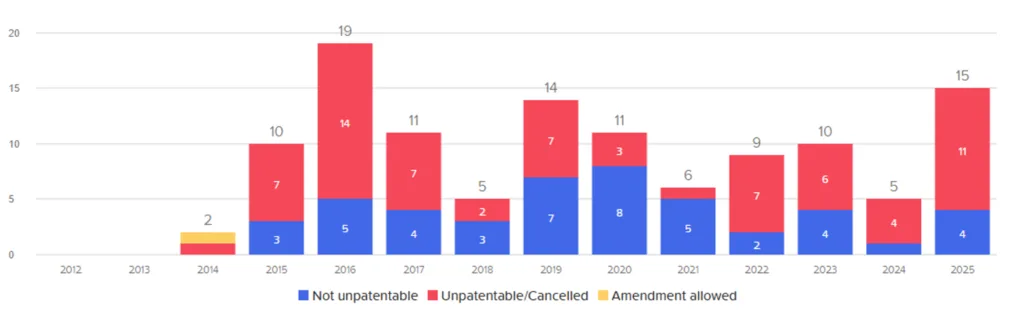
Of the 280 proceedings that were filed, Figure 4 shows that the PTAB issued a final decision determining patentability for 117 proceedings (this number omits any proceedings that were settled, dismissed or consolidated).
Between 2015 and 2020, for 70 proceedings, the PTAB determined that 40 (57%) had at least one unpatentable claim. And between 2020 and September 2025, the PTAB determined that 57% had at least one unpatentable claim (32 out of the 56 proceedings).
Taken together, these numbers show that over the last ten years, the PTAB has determined that 57% of the agricultural-related proceedings have at least one unpatentable claim.
Regarding ex parte reexaminations, over 15,500 have been filed since the introduction of ex parte reexaminations in 1981. Ex parte reexaminations have traditionally had an institution rate of just over 92%.[2]
For agricultural-related patents specifically, 26 ex parte reexaminations were appealed to the PTAB (2 of which were further appealed to the Federal Circuit) between 2012 and November 2025. Of these 26 appeals, 10 patents were upheld (38%), and 16 patents were partially or fully revoked (61%). As such, among appealed ex parte reexaminations, at least one claim is generally found unpatentable.
Recent Changes Impacting IPRs
In October 2025, the USPTO issued a Memorandum stating that Director Squires, in consultation with at least three PTAB judges, would determine whether to institute an IPR or PGR.[3]
Traditionally, IPRs saw an institution rate around 67%, but since Squires’ decision to institute IPRs himself, the IPR institution rate dropped to 0% in early November 2025,[4] and rose to around 35-55% in late December 2025 into early January 2026.[5] The USPTO additionally issued a Notice of Proposed Rulemaking that, if implemented, will make it more difficult to institute IPRs.[6]
With the recent decline in the IPR institution rate, PGRs and ex parte reexaminations are likely to become the preferred tools to challenge a patent. As such, the remainder of this article will focus on the lessons learned from PGRs and ex parte reexaminations involving agricultural-related patents.
Takeaways for Patent Owners and Petitioners From PGRs and Ex Parte Reexaminations
Below we examine when it may be beneficial for a petitioner to file a PGR or ex parte reexamination and share practical guidance with patent owners on strengthening intellectual property portfolios in the evolving agricultural patent landscape.
Takeaway #1: With the decline in the IPR institution rate, petitioners should consider filing an ex parte reexamination as an alternative option to challenge the patentability of a patent on 35 U.S.C. §§ 102 or 103 grounds.
For example, in Ex Parte Bayer Intellectual Property GmbH, two separate third parties requested ex parte reexamination of several claims in U.S. Pat. No. 7,105,470, directed to the use of herbicide combinations to control harmful plants in soybean crops, and the claims were ultimately canceled.[7]
An advantage of filing an ex parte reexamination is that unlike IPR and PGR proceedings, a third-party petitioner can file an ex parte reexamination anonymously and is not estopped from making the same unpatentability arguments in a later proceeding.
However, we note that the third party petitioner does not participate in an ex parte reexamination after filing the request like a petitioner does in an IPR or PGR. As such, a third party petitioner does not have the chance to make additional arguments during the reexamination process.
Takeaway #2: A further option for petitioners is to file a PGR, which additionally allows patent challenges based on written description and enablement.
A recent 2023 PGR, Syngenta Corp. Protection AG v. UPL Ltd., concerning a patent directed to a combination of fungicides, illustrated that PGRs can be an avenue for a petitioner to attack an agricultural-related patent.[8] In this case, the PTAB determined that claims 1-10 were unpatentable based on 35 U.S.C. §§ 102 and 103 grounds.
35 U.S.C. §§ 102 and 103 grounds, however, are not the only grounds available in a PGR proceeding. Unlike an IPR or ex parte reexamination, a PGR allows a petitioner to raise arguments on the grounds of 35 U.S.C. §§ 101 (eligibility) and 112 (written description and enablement).
As such, patent owners should be wary of possible written description and enablement attacks that may come 9 months after issuance in a PGR when prosecuting their patents. To withstand such attacks, patent owners should consider supporting their patent applications with working examples with actual data and/or prophetic examples.
Furthermore, written description and enablement can be especially difficult to satisfy for broad genus claims in agricultural biotechnology.[9] As such, patent owners claiming a genus should strive to provide working examples depicting data for several species or shared structural features within the genus.
Takeaway #3: A patent owner should keep the possibility of future litigation in mind and build robust claim sets and patent portfolios.
Investing in a robust claim set, i.e., layered claim sets with broad independent claims and multiple narrow dependent claims, is crucial as these narrow dependent claims can be “fall back” claims when challenged. The benefit of robust claims is illustrated by the proceedings surrounding U.S. Pat. No. 6,202,395, which had 34 claims directed to a combine header height control apparatus.[10]
Claims 1-11 and 27-34 of the ‘395 patent were found unpatentable for obviousness by the PTAB in two IPRs filed in 2015.
Specifically in one of the IPRs, independent claims 1 and 27 were found obvious over a combination of three prior art references. In contrast to independent claims 1 and 27, independent claim 12, from which claims 13-26 depended, had an additional limitation of a biasing means used to move the combine header’s arm to a selected inclined orientation.
In a subsequent ex parte reexamination of claims 12-26 of the same patent in 2016, the Examiner rejected claims 12-26 for obviousness and found that an additional fourth prior art reference rendered independent claim 12 obvious.
However, in 2018, the Examiner’s rejection was reversed on appeal because the Examiner’s rationale for combining the additional fourth reference with the original three prior art references from the IPR was based on hindsight bias. Additionally, in 2019 on remand, the PTAB instituted IPR of claims 12-26 for obviousness but found claims 12-26 not unpatentable.
Thus, even though claims 1-11 and 27-34 were found unpatentable, the patent owner was able to fall back on narrower claims 12-26.
Robust claim sets also provide the patent owner with more options in the face of a PGR, ex parte reexamination or other proceedings. A patent owner may cancel challenged claims and keep the remaining claims intact, thus terminating a proceeding to save time and money.
For a competitor, a patent with robust claims is more expensive and time consuming to attack. Additionally, the more claims a patent has, the more proceedings a competitor may have to file, as many petitions have word limits. As an illustration, both IPRs and the ex parte reexamination brought against the aforementioned ‘395 patent, were brought by the same third-party petitioner.
Additionally, building robust patent portfolios, i.e., creating a patent thicket, can be useful. A patent thicket includes obtaining multiple overlapping patents (for example, composition patents, formulation patents, manufacturing process patents, patents on improvements, etc.) each with robust claim sets. Thus, if one patent falls there are other patents upon which to rely.
Takeaway #4: A patent owner should include relevant experimental data, such as unexpected results, in the patent specification or in a declaration to traverse rejections.
For example, in Ex Parte Bayer Intellectual Property GmbH, the Examiner rejected the claims as being obvious over the prior art. Among several arguments on appeal, the patent owner argued that a synergistic effect between the claimed herbicides was unexpected.
Although the patent owner provided evidence that certain combinations of the claimed herbicides produced results that were more additive than each herbicide individually, the patent owner did not provide additional comparison data with respect to the other combinations of herbicides encompassed by the prior art. Thus, the patent owner could not show that the synergy was unexpected over the prior art.
In this case, and in similar cases, a patent owner should provide comparison data over the closest prior art (typically submitted via a 37 C.F.R. § 1.132 declaration in the U.S.), to traverse an obviousness rejection with unexpected results.
Takeaway #5: Patent owners and petitioners should be cognizant of how claims are construed in the various tribunals and understand that claim construction is fact-specific.
For example, in Ex Parte Husqvarna, the patent at issue was directed to a means for collecting cut grass, and during ex parte reexamination the Examiner rejected several of the patent claims.[11] Among other arguments on appeal at the PTAB, the patent owner argued that the terms “coupled to” and “mounted to” in the claims had different meanings, specifically that “mounted to” had a non-unitary construction.
However, the specification did not provide a definition for the term “mounted to” nor was there any explanation as to how “coupled to” and “mounted to” should be applied differently. As such, the PTAB determined that the meaning of “coupled to” also referred to a connection that is non-unitary.
In comparison, in Syngenta Corp. Protection AG, the specification did recite language that affected claim construction. Specifically, the terms “fungicidal combination,” “combination,” and “composition” needed construction.[12] The patent owner argued that all three terms should be construed to mean that the “fungicides are together in a single mixture.”
The PTAB, however, found that the specification repeatedly used the term “may,”[13] which suggested that the fungicide components did not have to be mixed before use, and the claimed combination of fungicides could be formed by the sequential application of the fungicides to a plant. As illustrated, it is important for patent owners to define terms in the specification to ensure that their intended interpretation is realized.
Claim construction should also be consistent across parallel PTAB and district court proceedings. To this point, in a recent Director Review Decision, the PTAB denied institution of an IPR because the PTAB accepted the petitioner’s claim construction that was inconsistent with the petitioner’s claim construction in a parallel district court litigation without explanation.[14]
In the same vein, patent owners/applicants need to be cognizant of prosecution history estoppel and prosecution admissions. If a patent applicant narrowed the claim scope during prosecution to circumvent the prior art, they may be precluded from broadening the claim scope during litigation. Again, consistency is key.
Conclusion
As agricultural innovations grow, patents can be used to protect these innovations, attract investment, support partnerships and shape competition in the market. As illustrated in the agricultural-related patent proceedings above, innovators can strengthen their patents by providing relevant experimental data, defining claim terms, and drafting robust claims sets.
Additionally, with the recent decline in the IPR institution rate, agricultural companies wanting to challenge a patent should consider filing PGRs and ex parte reexaminations.
[1] To see the total number of patents issued by the USPTO across several sectors of the agricultural industry between 2000-2014, and a previous discussion of the impact of IPRs on agriculture-related patents, please see the earlier published article Lessons From IPRs Involving Agriculture-Related Patents. Gaby Longsworth & Alex Wang, Lessons From IPRs Involving Agriculture-Related Patents, Law360 (Oct. 2016), available at https://bit.ly/41gFC2C.
[2] See Ex Parte Reexamination Filing Data, USPTO (Sep. 2024), available at https://bit.ly/4uyMPZf.
[3] See John Squires, Memorandum, USPTO (Oct. 2025), available at https://bit.ly/419QK1e.
[4] See e.g., Dennis Crouch, An Era of No: The USPTO’s New 0% Institution Rate, PatentlyO (Nov. 2025), available at https://bit.ly/3Nl2hYr.
[5] See e.g., Dennis Crouch, The Thaw Begins?: What’s Driving IPR Institutions Under Director Squires, PatentlyO (Jan. 2026), available at https://bit.ly/3PGauXK.
[6] This Notice of Proposed Rulemaking suggests adding four new sections (d, e, f, and g) to 37 C.F.R. § 42. Revision to Rules of Practice Before the Patent Trial and Appeal Board, 90 Fed. Reg. 48335, 48338-48341 (proposed Oct. 17, 2025) (First, the proposed rule would preclude instituting an IPR unless the Petitioner files a stipulation promising to not pursue invalidity challenges under 35 U.S.C. §§ 102 or 103 in other venues, like in a district court or the U.S. International Trade Commission. Second, the proposed rule would preclude institution of an IPR if (i) the patent claims were already found not invalid by a district court; (ii) the patent claims were already found not invalid by the U.S. International Trade Commission; (iii) the patent claims were found patentable or not unpatentable in a previous IPR, PGR, or ex parte reexamination; or (iv) if the Federal Circuit reversed a finding of invalidity or unpatentability. Third, the proposed rule would preclude institution of an IPR if a parallel proceeding is likely to reach a decision on the validity of a patent under §§ 102 or 103 before the final written decision of the IPR. Finally, the proposed rule adds an “extraordinary circumstances” caveat, which would allow a PTAB panel to refer an IPR to the Director to decide whether to institute an IPR in extraordinary circumstances, such as bad faith or a substantial change in a statute or Supreme Court precedent.).
[7] See Ex Parte Bayer Intellectual Property, Appeal 2017-011413, Reexamination Control 90/013,216 & 90/020,011 (P.T.A.B. 2018); see also U.S. Patent No. 7,105,470 C2.
[8] Syngenta Corp. Protection AG v. UPL Ltd., PGR2023-00017, Paper 58 (P.T.A.B. 2023).
[9] See Jorge Goldstein, § 5:2. Historical Context of the Law of Enablement in US Biotechnology Patent Law (2025); See e.g., Amgen Inc. v. Sanofi, 598 U.S. 594, 613 (2023) (holding that two patents claiming a genus of antibodies were not enabled because the specification only described 26 antibodies within the genus).
[10] Ex Parte Richard Gramm, Appeal 2018-006732, Reexamination Control 90/013,868 (P.T.A.B. 2018).
[11] Ex Parte Husqvarna, Appeal 2018-004746, Reexamination Control 90/013,820 (P.T.A.B. 2018).
[12] Syngenta Corp. Protection AG v. UPL Ltd., PGR2023-00017, Paper 58 (P.T.A.B. 2023).
[13] For example, the patent specification stated: “[t]he combinations of the present invention may be sold as a pre-mix composition or a kit of parts such that individual actives may be mixed before spraying.” Syngenta Corp. Protection AG v. UPL Ltd., PGR2023-00017, Paper 58 at 25 (P.T.A.B. 2023) (emphasis added). See also id., at 26 (stating that the patent specification disclosed that “the composition of the present invention maybe [sic] applied simultaneously as a tank mix or a formulation or may be applied sequentially.”) (internal quotations omitted) (emphasis added).
[14] Revvo Technologies, Inc. v. Cerebrum Sensor Technologies, Inc., IPR2025-00632, Paper 20, at 2-5 (P.T.A.B. 2025).
Originally printed in Thomson Reuters Westlaw on March 26, 2026. Reprinted with permission.
 Download
PDF
Download
PDF
 Read Full Article
Subscription Required
Read Full Article
Subscription Required
Related Industries
Related Services
Receive insights from the most respected practitioners of IP law, straight to your inbox.
Subscribe for Updates