Summer Associates Carson Story and Tash Medde-Witage contributed to this article.
Consider the ease of making a phone call on a smartphone, ordering from your favorite pizza place’s app, or playing the latest mobile game. You seamlessly tap, type, and swipe through a familiar set of screens and icons to make the call, place the order, or win big. This process becomes automatic. You might have a similar experience setting a navigation destination on the touch screen of your car. Or even choosing the right spin cycle on your washing machine.
The ease of use of these interfaces is no accident. Rather, it is the result of a series of well-designed graphical user interfaces (GUIs), each tailored to subtly and efficiently communicate with you, the user.
Well-crafted GUIs can become a recognizable extension of a company’s brand and a way to stand out against competitors. Investing in effective and appealing GUIs not only can improve the usability of a product, but it can also shape how the brand is perceived by users.
Whether on a smartphone, in a car, or on a home appliance, GUIs are a valuable asset to any company that interacts with its users through devices. As technology becomes increasingly integrated into everyday user experiences, companies are seeking ways to protect their GUIs and prevent them from being copied by others. That’s where design patents come in.
Protecting GUIs with Design Patents
Design patents are a subset of patents, but they differ in a few key ways from the more common utility patent. While utility patents protect the technical structure and function of a product or process, design patents protect the appearance of something—in this case, a graphical user interface—irrespective of its structure or function.
Smartphones illustrate this distinction well and highlight how design and utility patents can work together to achieve well-rounded protection for new technologies. Utility patents protect the hardware and software that power a modern smartphone, which developers spend countless hours coding. And design patents protect the overall look and feel that teams of designers meticulously curate for users.
Copyright law and trademark law can also supplement patents to provide comprehensive protection of new technology. While design patents can cover the overall look and feel of a GUI, copyrights protect specific creative expressions. This makes copyrights useful for protecting the specific art used as icons on apps and menu screens. Additionally, as technological developments become recognizable brands, trademarks can protect the brand image that consumers associate with those technologies.
GUIs of the Future
Smartphone GUIs are a useful demonstrative example because they are familiar to all of us. However, GUIs have expanded across screens of all types, and the use of design patents on those nontraditional screens has followed. For example, each member of this design patent family protects a distinct feature of a dashboard display screen:
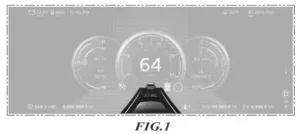
US D1,030,777, FIG. 2
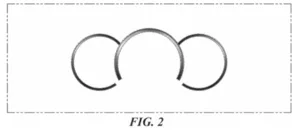
US D1,119,937, FIG. 2
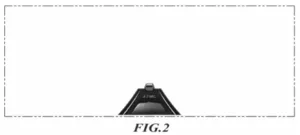
US D1,051,160, FIG. 2
Combined, the protected dashboard screen looks something like this:
US D1,051,160, FIG. 1
Recently, design patent protection for GUIs reached beyond screens entirely. In a notice to design patent examiners, the United States Patent and Trademark Office (USPTO) clarified that virtual reality, augmented reality, image projections, and holographic interfaces are all protectable by design patents.
For example, the USPTO said a keyboard interface, which is projected onto a desk or other work surface, can be protected by design patents.
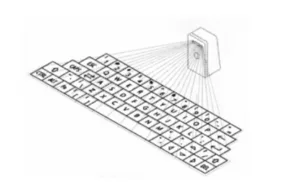
Supplemental Guidance for Examination, Mar. 13, 2026, Example 7
The three-dimensional design of a virtual reality motorcycle can also now be protected under this recent notice.
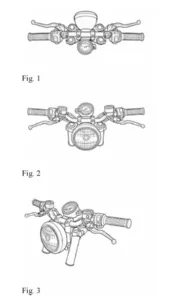
Supplemental Guidance for Examination, Mar. 13, 2026, Example 10
Conclusion
GUIs have become increasingly valuable as technology and digital screens become more integrated into everyday life. And just as technology is ever-evolving, design patent law is evolving alongside it. Recent developments at the USPTO have expanded design patent protection to more GUIs, regardless of whether they can be visualized on a display screen. Holographic images, projected designs, and virtual reality displays can all now be protected by design patents. As long as design applications are carefully drafted to satisfy the new guidelines, applicants now have more flexibility in the kinds of GUIs they can protect. For any questions about the new guidelines, please contact the authors of this article.
This article is the first installment in the Protecting Software with GUI Design Patents series.
Related Services
Receive insights from the most respected practitioners of IP law, straight to your inbox.
Subscribe for Updates