In 2025, design patent enforcement activity at the U.S. International Trade Commission (ITC) remained low but notable. Only two Section 337 disputes involving at least one design patent reached at least an Initial Determination: Certain Exercise Equipment and Subassemblies Thereof (Inv. No. 337-TA-1419) and Certain Women’s Flats with Colored Outsoles Thereof (Inv. No. 337-TA-1428). Inv. No. 337-TA-1428 was the sole dispute involving at least one design patent that reached a Final Determination. The decisions underscore that investigations are more likely to result in remedial orders when at least one design patent is asserted.
Design Patent Enforcement Trends
An analysis of cases reaching a Final Determination between 2015 and 2025 reveals that cases involving a design patent continue to obtain a remedial order at a significantly higher success rate than do utility patents.
From 2015 to 2025, the ITC terminated 429 Section 337 investigations, with 226 cases reaching a Final Determination of violation or no violation. The Commission found a violation and issued remedial orders in 132 of those cases.
Of the investigations that went to Final Determination:
- General Exclusion Orders (GEOs) were issued in 61% of the investigations asserting at least one design patent, compared to 12% for Section 337 investigations asserting utility patents only.
- Limited Exclusion Orders (LEOs) were issued in 39% of investigations asserting at least one design patent, compared to 44% for Section 337 investigations asserting only utility patents.
- Cease and Desist Orders (CDOs) were issued in 57% of the investigations asserting at least one design patent, compared to 41% for Section 337 investigations asserting only utility patents.
Overall, from 2015 through 2025, the Commission found a Section 337 violation in 83% of investigations reaching Final Determination and asserting a design patent, compared to only 56% of investigations asserting either just utility patents or unfair acts.
Broken Lines Can Present Big Breaks at the ITC
The Commission issued a remedial order in the sole design patent case that terminated in 2025: Certain Exercise Equipment and Subassemblies Thereof (Inv. No. 337-TA-1419). Complainant Balanced Body asserted one utility patent and two design patents: U.S. Design Patent No. D659,205 (“D’205 patent”) for a “Reformer Exercise Apparatus” and U.S. Design Patent No. D659,208 (“D’208 patent”) for a “Reformer Exercise Apparatus Footbar.” The asserted design patents covered the same product, Balanced Body’s Allegro 2 Reformer, but each one used a different combination of solid lines and broken lines to cover different embodiments of the Reformer design.
The Commission issued an LEO as to the claim of the D’205 patent. In that patent, nearly the entire design for a Reformer Exercise Apparatus is presented in solid lines; only the rope and double loop elements are presented in broken lines and therefore form no part of the claimed design.
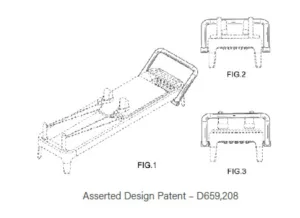
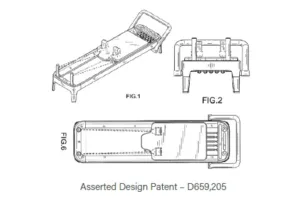
The Commission, in contrast, issued a GEO as to the claim of the D’208 patent, noting that all named respondents were found in default and a violation by at least one respondent had been shown. In that patent, almost the entire design is presented in broken lines—only the footbar element is presented in solid lines and is therefore the only element that forms part of the claimed design.
The Initial Determination in Certain Women’s Flats with Colored Outsoles Thereof similarly illustrates the potentially favorable impact that broken lines can have in a Section 337 investigation. There, complainant Gavrieli Brands initially asserted a family of seven design patents, each covering different ornamental aspects of Gavrieli’s Tieks shoe.
Gavrieli then withdrew two patents, narrowing the family of asserted design patents to just five: U.S. Design Patent Nos. D688,853 (“D’853 patent”), D844,951 (“D’951 patent”), D681,927 (“D’927 patent”), D681,928 (“D’928 patent”), and D686,812 (“D’812 patent”).
The D’853 patent, unlike the other asserted patents, presents three embodiments of the entire shoe in solid lines. The D’853 patent describes the stripes in Embodiment 2 as a blue color, such as Pantone PMS 3242-3278, PMS 2905-2995, and 7453C-7472C, and the checkered pattern in Embodiment 3 as the blue color Pantone 7466C.
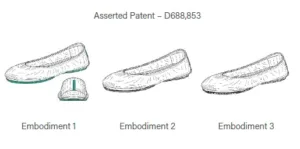
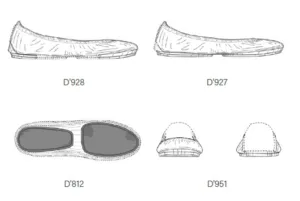
The administrative law judge (ALJ) determined that Respondents Piergitar, Bingxin Qingfeng, and tb249835650 “infringe the D’853 patent, and by extension, the D’951, D’927, D’928, and D’812 patents as well.” According to the ALJ, demonstrating infringement of the D’853 patent, which shows a complete shoe with no broken lines, “also demonstrates infringement of the D’927, D’928, and D’812 patents,” which show the same shoe but with varying portions shown in broken lines. The ALJ also reasoned that the D’951 patent would be infringed because its only difference from the D’927 and D’928 patents—a slightly altered opening rim—would make no difference to an ordinary observer.
Noting that Gavrieli successfully served all Respondents with the complaint and notice of investigation, but all failed to make any appearance or participate in any way and were therefore unlikely to follow an LEO, the ALJ recommended that the Commission issue a GEO.
This article appeared in the 2025 Design Patents: Analysis & Trends Year in Review report.
Related Industries
Related Services
Receive insights from the most respected practitioners of IP law, straight to your inbox.
Subscribe for Updates