2025 was a busy year for design patent cases at the U.S. Court of Appeals for the Federal Circuit. The court issued eight opinions involving U.S. design patents, including three precedential opinions. Below we discuss each of the three precedential opinions: Smartrend Manufacturing Group v. Opti-Luxx; Top Brand LLC v. Cozy Comfort Company; and Lashify v. ITC. These decisions further clarify the scope of design patent protection and who can bring a patent enforcement campaign at the U.S. International Trade Commission (ITC).
Smartrend Manufacturing Group v. Opti-Luxx
The Smartrend appeal deals with construction of terms that appear in the description of a design patent when the design patent recites the design “as shown and described.” The case involves school bus signs. Smartrend owns U.S. Design Patent No. D932,930 (the “D’930 patent”) and alleged that Opti-Luxx’s school bus sign infringed this patent (as well as one of its utility patents). The D’930 patent claims “[t]he ornamental design for an LED light panel, as shown and described.” Importantly, the patent’s description states that “oblique shading lines visible in the front and perspective views denote transparency.” Over Opti-Luxx’s objection, the district court construed the term “transparency” to mean both “transparent” and “translucent.”
The accused Opti-Luxx product is a single-piece illuminated school bus sign with a black housing, an LED light board, a yellow lens, and black lettering. According to Opti-Luxx, the black lettering on the accused product is totally opaque and the yellow lens is translucent such that light can pass through, but the LED light board behind it is not clearly visible. Images of the accused Opti-Luxx product are shown in the left-hand images, and Figures 1 and 2 of the patent are shown in the right-hand images.

During the district court trial, the jury was instructed that “[t]he Court has found the word transparency to mean both transparent and translucent. You must use this interpretation of the oblique lines when you consider infringement of the D’930 design patent claim.” Following the trial, the jury found that Opti-Luxx infringed the patent.
Opti-Luxx appealed the jury verdict. Among other things, Opti-Luxx argued that the district court erred in construing the term “transparency.” The Federal Circuit agreed. The Federal Circuit stated that while oblique shading in design patent figures typically indicates “transparent, translucent and highly polished or reflective surfaces,” here the patent’s description expressly narrowed the meaning of the oblique shading by stating that “oblique shading lines visible in the front and perspective views denote transparency.” Given this description, the Federal Circuit stated that the design claim is limited to surfaces that possess transparency and that transparency is not synonymous with translucency. The Federal Circuit concluded that in holding that “transparency” includes “translucent,” the district court erred, requiring a new trial as to infringement. The Federal Circuit thus vacated the jury verdict and remanded for a new trial.
Despite the ruling, the court left open the door to an argument that “transparency” includes translucent—if certain conditions are met. The court noted that Smartrend’s argument on remand may be that the term “transparency” has a special plain and ordinary meaning in the art of light-emitting devices. On remand, it will be appropriate for the district court to determine whether such an art-specific meaning of the term has been established such that the jury should be instructed as to such a meaning. But the court cautioned that merely conclusory testimony by experts that is unsupported by reliable extrinsic material is insufficient. If Smartrend wishes to make this argument (and make it stick on appeal), it would be well advised to point to special-purpose dictionaries or other objective evidence—separate and apart from expert testimony—to establish the meaning of “transparency” in the context of LEDs.
A key takeaway from this case for patentees is to be very careful in the language of the description and the claim—narrowing terms and descriptions will be held to limit the scope of claim coverage. All parties are also advised to look carefully for objective evidence if arguing that terms or descriptions have a special plain and ordinary meaning in the field of the patent.
Top Brand LLC v. Cozy Comfort Company
The Top Brand appeal discusses the impact of a design patent applicant’s statements during patent prosecution on future infringement analyses. The case involves two competitors in the oversized hooded sweatshirt market: Top Brand and Cozy Comfort. Top Brand had filed for a declaratory judgment that its sweatshirts do not infringe Cozy Comfort’s U.S. Design Patent No. D859,788 (the “D’788 patent”) and that the patent is invalid. In response, Cozy Comfort counterclaimed for infringement of both its design patent and two of its trademarks.
The D’788 patent is titled “Enlarged Over-Garment with an Elevated Marsupial Pocket” and claims “[t]he ornamental design for an enlarged over-garment with an elevated marsupial pocket, as shown and described.”
During prosecution, the examiner had initially rejected the design as anticipated by U.S. Patent No. D728,900 (White). To obtain allowance, Cozy Comfort agreed that its design differed from the White design. Cozy Comfort pointed to several ways in which it said its design differed from White with respect to the shape and placement of the marsupial pocket and the shape of the bottom hem line. For example, Cozy Comfort provided the examiner the below annotated comparisons of White’s design versus its design and told the patent office that (1) White’s pocket occupied roughly 90% of the torso’s width whereas the pocket in the inventive design was approximately one-third of the width of the torso, (2) the pocket on White is more angular and trapezoidal than the claimed pocket’s square-like shape, and (3) the bottom hem in White slopes upward from the front to the back whereas in the inventive design the bottom hem slopes downward.
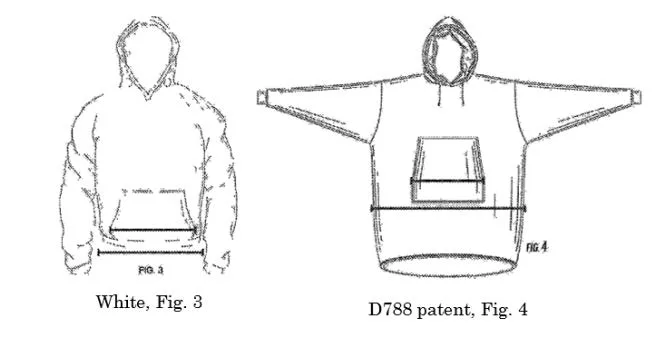
Top Brand argued that Cozy Comfort’s statements made during prosecution should limit the construction of the D’788 patent. The district court declined to adopt a limiting construction. The case proceeded to trial, after which a jury found infringement of both the patent and the trademarks. The jury awarded $15.4 million in disgorged profits for the D’788 patent infringement. Top Brand appealed the jury’s infringement finding.
On appeal, the Federal Circuit held that the principles of prosecution history disclaimer apply to design patents. The Federal Circuit agreed with Top Brand that, in distinguishing White, Cozy Comfort clearly surrendered its ability to rely on the surrendered claim scope in arguing for infringement. And the Federal Circuit held that the district court erred in failing to assess and describe the effect of Cozy Comfort’s statements during prosecution. The Federal Circuit stated that “to show infringement, Cozy Comfort cannot rely on features similar to those in White that were disclaimed during prosecution.”
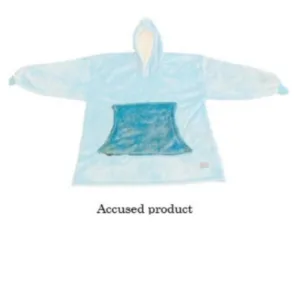
The Federal Circuit next compared the accused design with the patented design in view of this disclaimer and held that, as a matter of law, Top Brand does not infringe the asserted patent because Top Brand’s design is within the scope of the subject matter that Cozy Comfort surrendered during patent prosecution. For example, it stated that the front pocket of the accused products covers the majority of the width of the torso, like in White (and unlike in the claimed design), that the shape of the accused products’ pocket is similar to White’s trapezoidal pocket, and that the bottom hem in the accused product does not slope downward like the claimed design. Images of the accused product, White, and the patented design are shown above right.
The Federal Circuit concluded that multiple significant aspects of the accused product are the same ones Cozy Comfort disclaimed during prosecution and therefore reversed the jury’s infringement finding.
A key takeaway from this case is for both patentees and challengers to carefully consider statements and arguments made during prosecution when determining the scope of a design patent. Patent applicants would also be well served by carefully considering future implications of statements and arguments during prosecution.
Lashify v. ITC
Lashify was an appeal of a decision from the ITC. While the appeal focused on the statutory requirements of an ITC investigation, it has great impact for design patents.
Lashify is an American company and conducts its research, design, and development work in the United States but manufactures its eyelash extension products abroad. Lashify filed a complaint at the ITC alleging that companies importing and selling eyelash extension products infringed several of its patents, including two design patents.
Unlike patent infringement disputes heard in district courts, patent infringement disputes heard by the ITC require the patentee to show that “an industry in the United States, relating to the articles protected by the patent … exists or is in the process of being established.” 19 U.S.C. § 1337(a)(2).
This is often referred to as the domestic industry requirement. The statute states that “an industry in the United States shall be considered to exist if there is in the United States, with respect to the articles protected by the patent … concerned—(A) significant investment in plant and equipment; (B) significant employment of labor or capital; or (C) substantial investment in its exploitation, including engineering, research and development, or licensing.” 19 U.S.C. § 1337(a).
Lashify had argued that it had invested in “significant employment of labor or capital.” When evaluating this assertion, the ITC excluded expenses relating to sales, marketing, warehousing, quality control, and distribution. With these expenses excluded, the ITC found that Lashify had failed to meet the domestic industry requirement. Lashify appealed.
On appeal, Lashify argued that the ITC improperly excluded labor or capital that is used for selling, marketing, warehousing, quality control, and distribution. The Federal Circuit agreed with Lashify that the ITC had applied a legally incorrect understanding of the statutory test. The court found that the statute covers significant use of “labor” and “capital” without any limitation on the use within an enterprise to which those items are put. In particular, it held that there is no carveout of employment of labor or capital for sales, marketing, warehousing, quality control, or distribution. The Federal Circuit also stated that the statute’s use of “or” to separate the three clauses means that satisfying any one of the clauses suffices for satisfying the domestic industry requirement. The Federal Circuit thus vacated the ITC’s decision and remanded the case.
This decision opens the ITC as a potential venue for additional patent holders by making it easier for patent holders to prove the statutory domestic industry requirement. The ITC is a valuable tool for patent holders, particularly design patent holders. The remedy for patent infringement at the ITC is an order excluding infringing products from being imported into the United States. Exclusion orders can come in two forms: a limited exclusion order (which excludes only the products of the companies involved in the ITC investigation) or a general exclusion order (which excludes anyone’s infringing products—regardless of whether they were involved in the ITC investigation). As we have previously reported, the data shows that investigations involving at least one design patent are more likely to result in a general exclusion order and therefore have broader exclusionary effect.
This article appeared in the 2025 Design Patents: Analysis & Trends Year in Review report.
Related Industries
Related Services
Receive insights from the most respected practitioners of IP law, straight to your inbox.
Subscribe for Updates