2025 was a busy year for district courts, with multiple design patent trials and case-dispositive decisions. The year also brought the latest installment of the LKQ Corporation et al. v. General Motors Company et al. saga. We summarize three exemplary decisions discussing infringement, patentability, and obviousness. First, E. Mishan & Sons, Inc. d/b/a Emson v. Caraway Home, Inc. is a case out of the U.S. District Court for the Southern District of New York discussing the design patent infringement analysis. Second, this year’s LKQ is a decision out of the U.S. District Court for the Northern District of Illinois discussing design patent patentability. Third, Diode Dynamics, LLC v. 5DLight, Inc. is a case out of the U.S. District Court for the Central District of California that is one of the first cases to consider design patent obviousness under the Graham factors.
E. Mishan & Sons, Inc. d/b/a Emson v. Caraway Home, Inc.
Both E. Mishan & Sons, Inc. d/b/a Emson (“Mishan”) and Caraway sell cookware on Amazon. Caraway owns U.S. Design Patent No. D921,421 (“D’421 patent”), which claims “the ornamental design for a cookware lid.” Caraway filed a takedown notice with Amazon for Mishan’s listing, alleging that the lids on Mishan’s cookware infringe the D’421 patent. Mishan requested that Caraway withdraw its Amazon complaint, but Caraway did not do so.
Mishan then filed its own complaint in the Southern District of New York seeking a declaratory judgment that its lids do not infringe Caraway’s D’421 patent. After Caraway filed its answer, Mishan then moved for judgment on the pleadings under Federal Rule of Civil Procedure 12(c). Mishan argued that Caraway has no plausible claim that Mishan’s lids infringe Caraway’s patent.
The court stated that there are two levels to a design patent infringement analysis. Step one is a threshold analysis to determine if the accused design and the patented design are “substantially the same.” If the two are “plainly dissimilar” such that no ordinary observer would be deceived into believing the accused product is the same as the patented design, there can be no infringement and the analysis stops there. If the two designs are not plainly dissimilar, the analysis continues to step two, which considers the prior art and whether the similarities in the accused design and patented design are present in the prior art. If the accused design has features similar to the patented design and those features are absent in the prior art, the accused design is more likely to be regarded as deceptively similar to the claimed design and thus infringing.
Mishan argued that its lid is so plainly dissimilar from the patented design that, without even considering any prior art, no reasonable fact finder could conclude that the two appear “substantially the same.” Images of Mishan’s lids are shown below on the left and images of the patented design are shown on the right.
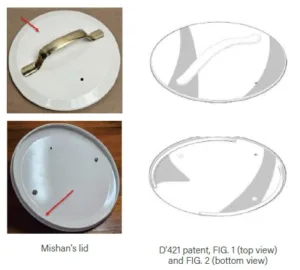
The court agreed with Mishan that this is a rare case in which the designs are “plainly dissimilar” such that no ordinary observer would be deceived into thinking that Mishan’s lid is the same as the patented lid—even without using the prior art as a frame of reference. In particular, the court found two key differences: (1) the patented lid has a totally flat top surface, whereas Mishan’s lid has a top surface that slopes near the circumferential perimeter and a convex center; and (2) the patented lid’s bottom includes two separate semicircular flanges, whereas the bottom of Mishan’s lid has a single flange that comprises a continuous circular wall. The court concluded that it cannot be said by any measure that the resemblance between the two lids is such as to deceive an ordinary observer, inducing him to purchase one supposing it to be the other. Thus, the court decided it did not need to proceed to step two, which was good for Mishan because the court held that Mishan could not rely on prior art in its Rule 12(c) motion when that prior art was attached to Mishan’s (the movant’s) filing.
With the rise of nontraditional venues (such as Amazon’s takedown process), this case provides a useful avenue for companies on the receiving end of takedown notices. However, it also highlights the importance of what to include (or not include) in the pleadings and how the available arguments can be limited by the pleadings.
LKQ Corporation et al. v. General Motors Company et al.
For anyone who has not been following design patent litigation for the past few years, in 2024 the LKQ v. GM saga brought the first en banc Federal Circuit patent decision in over five years. The decision addressed—and revoked—the long-standing Rosen-Durling obviousness analysis that had been applied to design patents for decades. In its place, the court said the four Graham factors—a test historically applied to assess the obviousness of utility patents—should apply to design patents, although the court left the challenge of determining precisely how the utility patent test would apply to design patents to later cases. 2025 has yet another installment in the LKQ v. GM saga—this time pertaining to patentability.
The case originally started when LKQ initiated a declaratory judgment action against GM regarding two of GM’s design patents: U.S. Design Patent Nos. D818,406 (the “D’406 patent”) and D828,256 (the “D’256 patent”). LKQ was once a licensed repair part vendor for GM. But after renewal negotiations fell through in early 2022, GM informed LKQ that the parts LKQ was selling were no longer licensed and therefore infringed GM’s design patents. In response, LKQ sought a declaratory judgment that it did not infringe and that the patents are invalid.
Of relevance to this year’s decision, LKQ argued that the patents are directed to unpatentable subject matter (and therefore invalid) because they cover only a portion of a final product. Both of the patents at issue claim the ornamental design for a front vehicle fender, which is undisputably part of a larger vehicle. 35 USC § 171 provides that “[w]hoever invents any new, original and ornamental design for an article of manufacture may obtain a patent therefor, subject to the conditions and requirements of this title.” Based on the fact that the two patents are directed to only the fender (rather than the complete vehicle), LKQ argued that (1) the designs are not applied to an “article of manufacture” as the fender is not complete in itself, and (2) GM invented a full car, so the patents referencing only the fender of the car do not disclose all material aspects of GM’s invented design but only a “fragment of a design.” GM moved for summary judgment as to both of these patentability challenges.
The court found that both of LKQ’s arguments make the same critical and flawed assumption: that a design patent is invalid as to a component part. The court held that these arguments were foreclosed by binding law. First, with regard to LKQ’s article of manufacture argument, the court said the Supreme Court has held that the fact that a component is later “integrated into a larger product” does not mean that it is not an article of manufacture. Second, with regard to LKQ’s fragment of a design argument, the court said the Federal Circuit has explained that design patents can claim the complete product or only a portion of a product. Thus, the court granted GM’s motion for summary judgment that the claims are not directed to unpatentable subject matter under 35 USC § 171.
This decision confirms the long-standing precedent that design patents are not improper if they claim a part or component of a larger article.
Diode Dynamics, LLC v. 5DLight, Inc.
This is one of the first cases to assess design patent obviousness under the four Graham factors. The case originally began when Diode Dynamics filed a complaint against 5DLight alleging that 5DLight’s aftermarket automotive lighting product infringes its U.S. Design Patent No. D974,648 (the “D’648 patent”). 5DLight responded that it does not infringe and that the patent is invalid. The D’648 patent is entitled “LED Lamp Bezel” and claims “the ornamental design for a LED lamp bezel, as shown and described.”
Diode Dynamics moved for summary judgment that 5DLight’s assertion of obviousness under Section 103 fails as a matter of law. 5DLight’s Section 103 argument was that the D’648 patent would have been obvious in view of Chinese Design Patent No. CN304206980 (“CN ’980”) and U.S. Design Patent No. D735,909 (“Ko”). 5DLight’s argument was that a designer of ordinary skill would have combined Ko’s edge detailing with the overall shape disclosed in CN ’980 to produce a design substantially similar to the D’648 patent. Images of the two prior art references and the patented design are shown below.
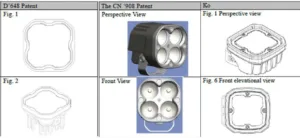
Looking first to the two prior art references, the court found that CN ’980 discloses a generally four-sided LED bezel design, while Ko discloses a vehicle lamp with flared, beveled edges and inset straight-edged center segments. The court found that while both CN ’980 and Ko qualify as analogous art, they differ substantially in both geometry and visual impression. For example, the court stated that Ko’s flared corners and stepped facets interrupt the proportional symmetry of CN ’980’s bezel. The court also found that nothing in the record suggests that these styles were commonly combined or visually compatible.
Turning to the asserted patent, the court found that the patented design diverges from both prior art references. For example, it lacks the aggressive fins and angular embellishments of Ko and the smooth contours of CN ’980. Instead, it features flat outer edges, distinctive beveled corners, and recessed center portions on each side—elements that neither of the prior references alone disclose. The court also found that 5DLight offered no record-supported reason why a designer would have been motivated to merge aspects of Ko and CN ’980 to arrive at the patented design. Because of the differences between the patented design and the prior art and the lack of a motivation to modify the prior art, the court found that no reasonable fact finder could find the claim obvious. The court thus granted Diode Dynamics’ summary judgment motion that the patent was not obvious.
As one of the first cases to apply the four Graham factors—which have historically been applied to utility patents—to a design patent, this case is certainly one to read and understand. Although the majority of the legal section cites to utility patent cases, the decision sets forth a framework that other courts may follow for applying the Graham factors to design patent claims.
This article appeared in the 2025 Design Patents: Analysis & Trends Year in Review report.
Related Services
Receive insights from the most respected practitioners of IP law, straight to your inbox.
Subscribe for Updates