As in 2024, inter partes activity involving design patents at the U.S. Patent Trial and Appeal Board (PTAB) was low in 2025. The PTAB rendered only two inter partes decisions involving design patents. Neither was subject to the bifurcated process introduced by the U.S. Patent and Trademark Office (USPTO) on March 26, 2025. And suggesting that 2026 will also be a quiet year at the PTAB for inter partes review, the PTAB also received only one petition challenging the validity of a design patent, which was filed in September 2025 and remains pending as of December 6, 2025.
An analysis of inter partes PTAB decisions between 2013 and November 2025 reveals that, relative to 2024, the design patent institution rate dropped slightly and the design patent invalidation rate at the final written decision stage remained steady. The current institution rate for design patents is 37%, which is significantly lower than the roughly 64% utility patent institution rate. The design patent claim invalidation rate at final written decisions in 2025 remains at the previous year’s 65% rate, with similar cancellation rates for both inter partes reviews (IPRs) and post-grant reviews (PGRs). By comparison, the utility patent claim cancellation rate at the final written decision is approximately 75%.
PTAB Continues Rigorous Approach to Assessing Design Obviousness post-LKQ
The two PTAB inter partes decisions issued in 2025 declined to institute inter partes review of the challenged design patents. These decisions indicate that proving obviousness of a design, at least before the PTAB, remains difficult post-LKQ, despite the Federal Circuit’s adoption of the more flexible Graham-factors framework in place of the former Rosen-Durling test to assess design patent obviousness.
A&A Global Imports, Inc. v. Lerman Container Corporation, IPR2024-01138, Paper 7 (PTAB Jan. 22, 2025)
Petitioner A&A Global Imports requested inter partes review of Lerman Container’s U.S. Design Patent No. D781,151 S for a jar design. Relying on prior commercial products and three design patents, Petitioner advanced four grounds of obviousness against the patented design.
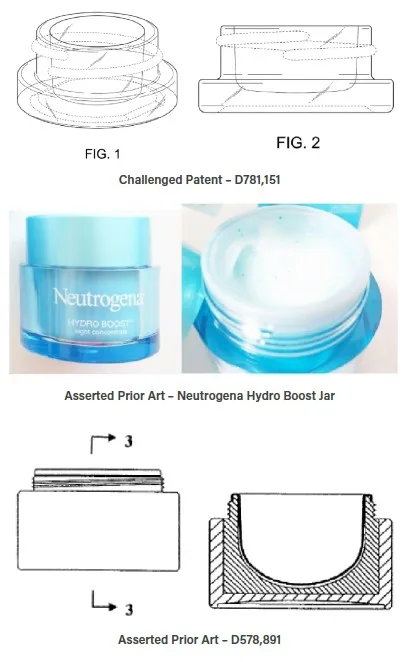
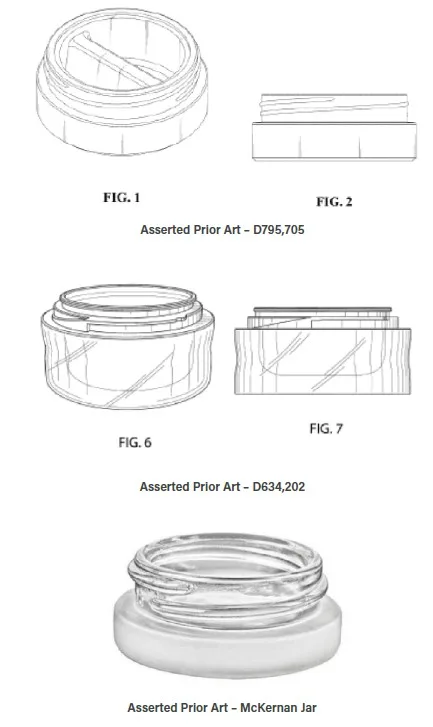
The PTAB denied institution, finding that Petitioner’s proposed combinations failed to address several key differences between the claimed design and the cited references: the base-to-neck height proportions and the shape and depth of the interior compartment. The PTAB emphasized that Petitioner did not explain why a designer of ordinary skill in the art would have overlooked these differences or found them so minor as not to affect the overall impression of the jar design resulting from the proposed combinations. According to the PTAB, in the crowded field of jar designs, each of these differences was more than de minimis and contributed significantly to the claimed design’s overall visual impression.
Arashi Vision (U.S.) LLC (D/B/A Insta360) v. GoPro, Inc., IPR2024-01434, Paper 9 (PTAB Mar. 31, 2025)
Petitioner Insta360 requested inter partes review of GoPro’s U.S. Design Patent No. D789,435 S for a camera design. Petitioner purported to assert six grounds of obviousness (each based on a different primary reference), but the PTAB determined that Petitioner effectively presented at least 24 distinct grounds.
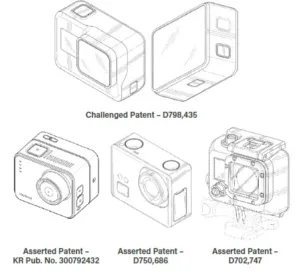
The PTAB declined to institute inter partes review. For the first purported ground, which relied on various web pages that Petitioner treated collectively as a single primary reference, the PTAB found that Petitioner failed to demonstrate that the web pages were publicly available prior to the critical date. One web page lacked a corresponding Wayback Machine affidavit, and the web pages that did include affidavits appeared to have different content than the document attached to the corresponding Wayback Machine affidavit. The PTAB also criticized Petitioner’s treatment of the various websites as a single prior art reference as contrary to the requirement that “a primary reference needs to be something in existence—not … something that might be brought into existence by selecting individual features from prior art and combining them.”
For the remaining grounds, the PTAB determined that Petitioner had not sufficiently addressed each asserted primary reference’s overall visual similarity to the claimed design. Instead, Petitioner focused on certain design features, which the PTAB found indicative of hindsight reconstruction of the claimed design rather than the objective teachings of the cited references. Petitioner failed to address all differences between the claimed design and each asserted primary reference and did not adequately explain why a designer of ordinary skill would modify each asserted primary reference with any of the cited secondary references.
New PTAB Institution Procedures Pose New Hurdles to Design Patent Challenges
Beyond the substantive developments reflected in the pair of PTAB decisions, 2025 also marked notable procedural changes to the PTAB institution phase for challenging U.S. patents, including design patents. In March 2025, the USPTO’s acting director issued a memorandum implementing interim procedural changes applicable to IPR and PGR challenges where the deadline for a patent owner’s preliminary response falls after March 26, 2025.
Under the interim procedures, the patent owner may file a discretionary denial brief addressing factors such as the party’s settled expectations, including the length of time the patent has been in force. A petitioner may file an opposition brief, which is due on the same date as the patent owner’s preliminary response. The USPTO Director, in consultation with at least three PTAB judges, then evaluates whether discretionary denial is warranted. If the discretionary factors weigh against denial, the USPTO Director would refer the petition to a three-member panel of PTAB judges for consideration of the merits and other nondiscretionary factors, followed by a reasoned decision on institution.
In October 2025, the new USPTO Director issued a memorandum refining the interim procedural changes. The updated approach limits institution decisions to summary notices and refers petitions to at least one PTAB judge for detailed treatment only when the Director deems it appropriate. In all other cases, the Director, in consultation with at least three PTAB judges, determines whether to institute proceedings based on discretionary considerations, the merits, and nondiscretionary considerations.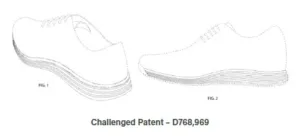
The sole design patent challenge filed in 2025, which involves Cole Haan’s U.S. Design Patent No. D768,969 for a shoe midsole, is the first design patent challenge subject to the October 2025 procedures. Cole Haan timely filed its discretionary denial brief and has not yet filed its preliminary response. As of December 6, 2025, Petitioner Top Glory Trading Group has not yet filed its opposition brief.
Taken together, the PTAB’s recent institution denials and the USPTO’s 2025 procedural changes reflect an increasingly demanding environment for design patent challengers, where both the substantive merits and the procedural posture of a petition carry heightened significance.
This article appeared in the 2025 Design Patents: Analysis & Trends Year in Review report.
Related Industries
Related Services
Receive insights from the most respected practitioners of IP law, straight to your inbox.
Subscribe for Updates