2026 Summer Associates Annie Quinn and Peter Schroen contributed to this article.
Legal or not, the future of the cannabis and psychedelics industries looks bright. In the last five months alone, government and commercial activity have skyrocketed.
In April, the U.S. Department of Justice rescheduled FDA-approved medical marijuana products and state-regulated medical marijuana from Schedule I to Schedule III substances, and the U.S. Drug Enforcement Administration held hearings in June and July on rescheduling all marijuana to Schedule III.[1]
Meanwhile, the White House issued an executive order in April, expanding access to psychedelic compounds that have received breakthrough therapy designations for treating serious mental illnesses, and allocating $50 million for psychedelics research.[2]
And in August, the U.S. Department of Veterans Affairs announced it will be conducting psilocybin clinical trials for treatment-resistant depression in veterans.[3]
On the commercial front, Otsuka Pharmaceutical announced in March its $1.225 billion acquisition of the psychedelics drug company Transcend Therapeutics; and in July, Eli Lilly announced its $2.8 billion acquisition of the biotech company AtaiBeckley.[4]
Amid these regulatory shifts and growing markets, the patent arms race in cannabis and psychedelics innovation continues. Innovators seeking to stake their claim in these fields will consequently need to understand the unique patent landscape they will encounter when seeking patent protection.
To this end, this article evaluates cannabis and psychedelics market growth, surveys current trends in patent filing activity at the U.S. Patent and Trademark Office, and reviews recent litigation related to cannabis and psychedelics technologies.
Surging Cannabis and Psychedelics Markets
No longer relegated to the peripheries of the U.S. economy, the cannabis and psychedelics markets are surging. Analysts have projected that in North America alone, the cannabis market, which includes CBD, CBN and terpene products, will grow from $38.5 billion in 2024 to over $100 billion in 2035.[5] Analysts estimate the psychedelics industry in the U.S. to grow from approximately $4 billion in 2025 to over $12 billion in 2034.[6]
Industry growth is also evident in the boom of cannabis- and psychedelics-based clinical trials. ClinicalTrials.gov currently lists over 1,100 clinical trials in which the intervention or treatment is related to cannabis, including about 300 currently active trials, over 60 of which were initiated since Jan. 1.[7] Many of these trials are investigating cannabis as a therapeutic agent to treat conditions including eating disorders, depression, anxiety and post-traumatic stress disorder.
Likewise, ClinicalTrials.gov lists hundreds of clinical trials for a variety of psychedelic compounds, a few examples of which are shown below:
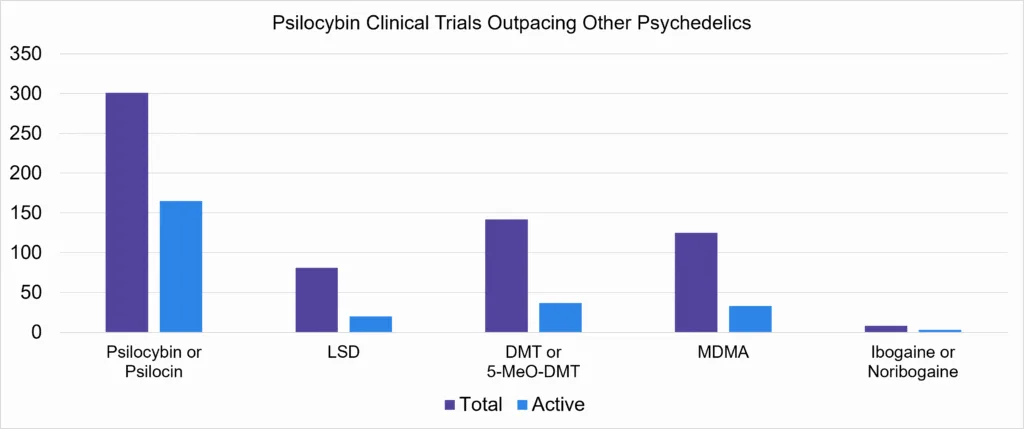
Currently active trials are studying the psychedelics for treating conditions such as depression, cluster headache, premenstrual disorder, opioid dependence, borderline personality disorder and alcoholism. Notably, psilocybin clinical trials have outpaced other psychedelic compounds by far — consistent with the VA’s recent announcement of its trials studying psilocybin for treatment-resistant depression in veterans.[8]
Patent Activities Mirroring Market Growth
In parallel with the market growth, patent filing activity (and relatedly, patent grants) in the cannabis and psychedelics fields has ballooned over the past decade.
Cannabis Filings Are Blooming
The total number of published patent applications and granted patents claiming cannabis-related products shows a massive surge in filing activity beginning around 2014.[9] Indeed, the number of cannabis-related patent applications increased by over 400% between 2014 and 2022. A similar trend line is evident in the cannabis-related patent grants.
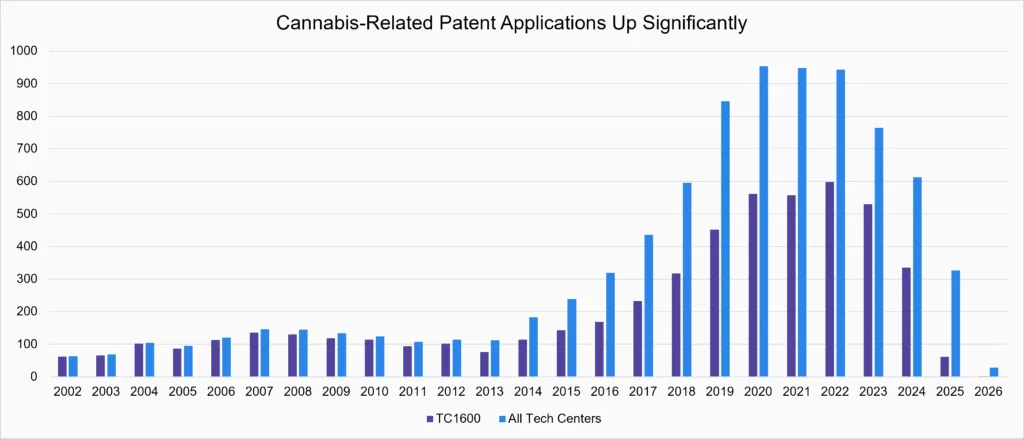
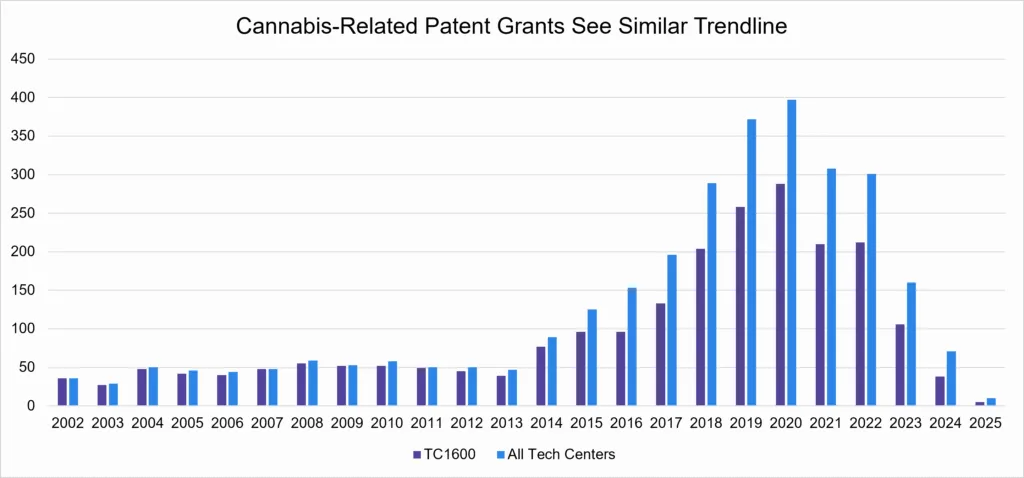
Several events that caused a change in the perceived regulatory environment for cannabis coincide with this surge.
Colorado and Washington both legalized adult recreational use of cannabis in 2012. Other states soon followed, leading to optimistic projections for the recreational cannabis industry. The 2014 Farm Bill created a pilot program allowing hemp cultivation for research purposes in certain states. And the 2018 Farm Bill legalized products that contain no more than 0.3% delta-9 THC by dry weight, i.e., hemp.
While at first glance there appears to be a drop in filings from 2023-2025, many filings from recent years have yet to publish, and still others that started as PCT applications have not yet entered the U.S. national stage. Thus, we expect a decline from the peak filings in 2020-2022, with numbers still remaining well above the pre-2014 baseline numbers.
Additionally, the data shows that the majority of cannabis-related filing activity over the past decade was in TC1600 (biotechnology and organic chemistry). The technology centers handling the next highest numbers of cannabis-related applications are TC1700 (chemical and materials engineering), TC3600 (agriculture et al.), and TC3700 (mechanical engineering).
Thus, as the cannabis market grows, so, too, does the intellectual property around not just the active cannabinoid compounds, formulations or methods of use, but also cannabis-related innovations, such as extraction processes, plant and agriculture technologies, and mechanical devices for use with cannabis products.
The Psychedelic Renaissance
Psychedelics patent filings have also increased significantly recently. Here, we examined the number of published patent applications and granted patents claiming selected psychedelics-related active ingredients (psilocybin, ibogaine, LSD, MDMA, DMT).[10]
As shown below, psychedelics-related patent filings increased by over 300% between 2019-2022, with the majority of filings related to psilocybin, followed by LSD and MDMA. The number of granted patents in the psychedelics space showed similar trends.
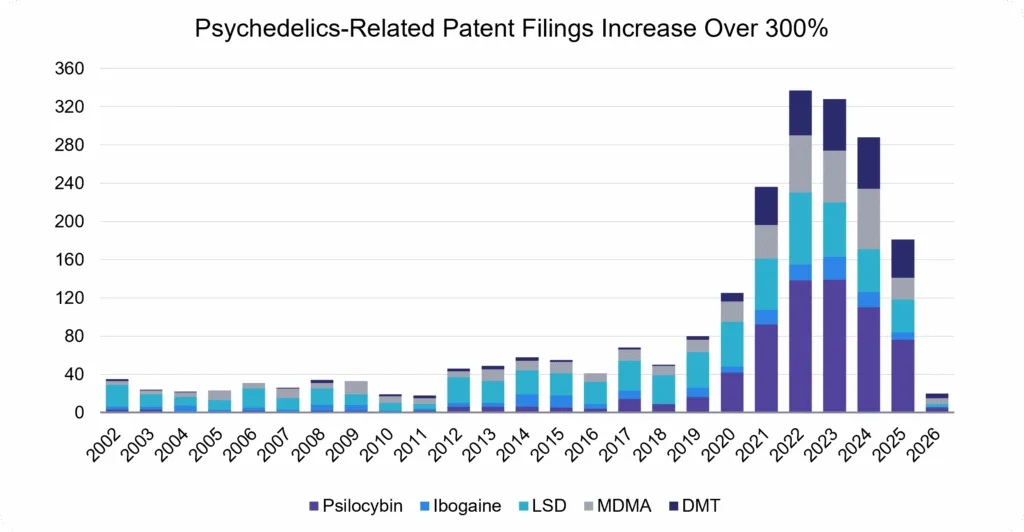
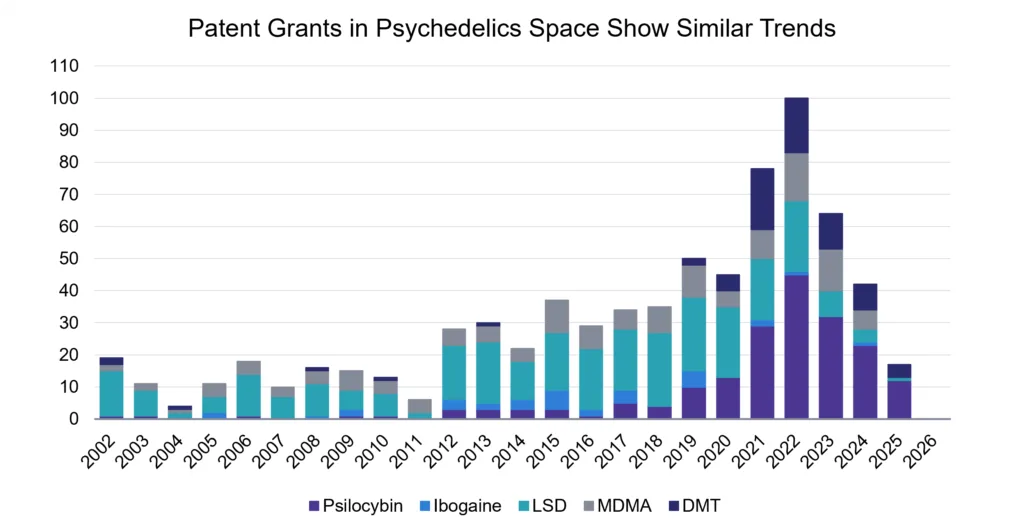
The surge in psychedelics filings, like that seen in cannabis-related filings, was likely also driven by a convergence of events.
The FDA granted breakthrough therapy designation to MDMA for PTSD in 2017,[11] to psilocybin for treatment-resistant depression in 2018,[12] and again to psilocybin for major depressive disorder in 2019.[13] These designations signaled that the FDA legitimately considered these therapies as potentially clinically beneficial, changing the dogma that psychedelics were commercially unrealistic. The FDA also approved Spravato (esketamine) in 2019 for treatment-resistant depression — the first FDA approval of a psychedelic for psychiatric use.[14]
Meanwhile, pharma companies dedicated to developing psychedelic drugs were raising hundreds of millions of dollars in financing, including several that went public: Compass Pathways[15] and Field Trip Health[16] in 2020, and Atai Life Sciences[17] MindMed[18] and Cybin[19] in 2021.
And while federal law did not change, some states and localities made regulatory changes for psychedelics during this time frame. For example, Denver decriminalized psilocybin mushrooms in 2019[20] and Oregon legalized psilocybin in 2020 for adult use under regulated framework.[21] Collectively, these events are all part of a psychedelic renaissance — a revived interest in psychedelics — further evident from both market growth and the surge in patent filings.
Rising Rejections at the USPTO
Patent applications related to cannabis and psychedelics may be more prone to subject matter eligibility rejections under Title 35 of the U.S. Code, Section 101, depending on how the invention is claimed.
Cannabinoids and terpenes of course come from the naturally occurring hemp plant. And many psychedelics are derived from naturally occurring plants or mushrooms. Thus, claims directed to novel and nonobvious formulations, methods of use, or structural analogs of certain compounds can help avoid eligibility rejections over the naturally occurring compound.
Until recently, pharma-related cannabis and psychedelics patent applications were often more vulnerable to enablement rejections under Title 35 of the U.S. Code, Section 112, because such applications typically contained less clinical data compared to other pharmaceutical patent applications. However, as clinical research in these areas continues to grow, and along with it more clinical trials and resultant data included in the application, traditional, data-driven arguments can be used to overcome Section 112 rejections.
The other side of this coin is that patent applicants will encounter more prior art as clinical trial results and other reports continue to publish, increasing the potential for anticipation and obviousness rejections under Title 35 of the U.S. Code, Sections 102 and 103, respectively.
Indeed, while many traditional users of psychedelics did not record their practices or methods in a way that would be easily accessible to patent examiners, various resources dedicated specifically to collecting prior art and patent publications on psychedelics are now available.[22]
Cannabis and Psychedelics Litigation
As patents related to cannabis and psychedelics have grown in number, so have patent disputes. Such litigation activity demonstrates that patent owners are asserting their rights without fear that tribunals will treat their cases differently due to the checkered regulatory statuses of cannabis and psychedelics.
Recently, cannabis vaporize company PAX Labs Inc. successfully asserted patents directed to the mechanical components of vaporizing devices configured to prevent leakage of materials, including cannabis oils, against retail cannabis chain Stiizy Inc. at the International Trade Commission.[23] The case, Stiiizy v. ITC, is currently pending on appeal at the U.S. Court of Appeals for the Federal Circuit.
Cannabis-related district court litigation has also been active. Natural Extraction Systems, a natural product extraction and distillation technologies company, filed a string of suits in January against Green Thumb Industries Inc.,[24] Stiiizy Inc.,[25] Surterra Texas LLC[26] and Trulieve Inc.[27] alleging infringement of patents covering methods of decarboxylating cannabinoids.
In its district court complaints, NES noted that its founder and inventor deliberately shifted focus to cannabinoid extraction methods following the 2018 Farm Bill, patented his new methods, and is now asserting the NES patents against makers of cannabis distillate, demonstrating how shifting federal cannabis regulations can affect not only the number of cannabis-related patent filings, but also cannabis-related litigation.
There has also been a recent flurry of multidefendant litigations involving cannabis patents. In 2025, Metronome LLC filed suit — all since voluntarily dismissed — against 18 different defendants alleging infringement of patents directed to topical cannabis compositions.[28]
This summer, Global IP Holdings LLC asserted its patents directed to low-temperature ethanol extraction of cannabinoids and terpenes against multiple defendants, including Verano Holdings LLC,[29] Columbia Care Eastern Virginia LLC,[30] Freestate Wellness LLC,[31] FGM Processing LLC,[32] Atraxia LLC,[33] and GVB Biopharma.[34]
While we did not identify any district court or ITC litigation regarding psychedelics patents, a few have been subject to America Invents Act challenges at the Patent Trial and Appeal Board, albeit in proceedings that did not proceed past the institution phase.
Porta Sophia,[35] a nonprofit organization, for example, requested inter partes review of Monster Color Carnival’s U.S. Patent No. 11,235,110, directed to a vaporizer for delivering psychedelic substances, which was not instituted after Monster Color Carnival statutorily disclaimed every challenged claim.[36] Gilgamesh Pharmaceuticals petitioned for post-grant review of Enveric’s U.S. Patent No. 12,138,276, directed to halogenated psilocybin derivatives, then voluntarily terminated the proceeding.[37]
Given the volume of cannabis- and psychedelics-related patent activities in recent years, and the rapidly growing markets for these industries, we expect to see a continued increase in litigation in these spaces.
Conclusion
As commercial interest accelerates, clinical trials expand and dedicated repositories compile historical knowledge, the scope of publicly accessible prior art — from scientific literature to clinical trial data — is expanding dramatically.
This shift creates a double-edged sword for patent applicants. Beyond navigating subject matter eligibility hurdles under Section 101 when dealing with naturally derived compounds, patent applicants must now clear a much higher bar for novelty and nonobviousness set by this growing body of prior art.
Yet, as the sector matures, innovation is keeping pace. Much like traditional pharmaceuticals, technological advances are giving rise to new patentable subject matter, including novel optimized formulations, synthetic derivatives, extraction processes and specialized methods of treatment or delivery.
To successfully navigate this evolving landscape, applicants must formulate their IP strategy early, carefully aligning patent filings and claim scopes with clinical development milestones, regulatory approval pathways and statutory exclusivity windows.
Originally printed in Law360 on September 10, 2026. Reprinted with permission.
[1] https://www.dea.gov/marijuana-rescheduling-regulatory-actions; https://www.whitehouse.gov/presidential-actions/2025/12/increasing-medical-marijuana-and-cannabidiol-research/.
[2] https://www.whitehouse.gov/fact-sheets/2026/04/fact-sheet-president-donald-j-trump-is-accelerating-medical-treatments-for-serious-mental-illness/.
[3] https://news.va.gov/press-room/va-launches-psilocybin-trial-for-veterans-with-treatment-resistant-depression/.
[4] https://transcendtherapeutics.com/otsuka-pharmaceutical-to-acquire-transcend-therapeutics/; https://investor.lilly.com/news-releases/news-release-details/lilly-acquire-ataibeckley-advance-therapies-treatment-resistant.
[5] https://www.grandviewresearch.com/industry-analysis/us-cannabis-market; https://finance.yahoo.com/news/legal-cannabis-market-size-reach-130000009.html.
[6] https://www.snsinsider.com/reports/psychedelic-drugs-market-7467; https://www.verifiedmarketreports.com/product/psychedelic-drugs-market/.
[7] https://clinicaltrials.gov.
[8] https://news.va.gov/press-room/va-launches-psilocybin-trial-for-veterans-with-treatment-resistant-depression/.
[9] Published applications and granted patents are graphed based on underlying application filing date.
[10] Published applications and granted patents are graphed based on underlying application filing date.
[11] https://maps.org/2017/08/16/fda-grants-maps-breakthrough-therapy-designation-for-phase-3-trials-of-mdma-assisted-psychotherapy-for-ptsd/.
[12] https://www.prnewswire.com/news-releases/compass-pathways-receives-fda-breakthrough-therapy-designation-for-psilocybin-therapy-for-treatment-resistant-depression-834088100.html.
[13] https://www.usonainstitute.org/updates/fda-grants-breakthrough-therapy-designation-to-usona-institutes-psilocybin-program-for-major-depressive-disorder.
[14] https://www.jnj.com/media-center/press-releases/janssen-announces-u-s-fda-approval-of-spravatotm-esketamine-ciii-nasal-spray-for-adults-with-treatment-resistant-depression-trd-who-have-cycled-through-multiple-treatments-without-relief.
[15] https://ir.compasspathways.com/News–Events-/news/news-details/2020/COMPASS-Pathways-announces-closing-of-initial-public-offering-of-American-Depositary-Shares-and-full-exercise-of-underwriters-option-to-purchase-additional-American-Depositary-Shares/default.aspx.
[16] https://www.prnewswire.com/news-releases/field-trip-health-ltd-to-commence-trading-on-the-cse-on-october-6-under-ticker-symbol-ftrp-301145891.html.
[17] https://ir.ataibeckley.com/news-releases/news-release-details/atai-life-sciences-announces-pricing-upsized-initial-public.
[18] https://ir.definiumtx.com/news-events/press-releases/detail/105/mindmed-begins-trading-on-nasdaq.
[19] https://ir.helus.com/news-releases/news-release-details/cybin-commence-trading-nyse-american-august-5.
[20] https://www.npr.org/sections/health-shots/2019/05/09/721660053/in-close-vote-denver-becomes-first-u-s-city-to-decriminalize-psychedelic-mushroo.
[21] https://www.cnbc.com/2020/11/04/oregon-becomes-first-state-to-legalize-magic-mushrooms-as-more-states-ease-drug-laws.html?msockid=1258a41d6dd568cb3255b2bd6cc7695c.
[22] https://www.portasophia.org/; https://psychedelicalpha.com/resources/; https://psychedelics.berkeley.edu/patent-tracker/.
[23] Certain Oil Vaporizing Devices, Components Thereof, and Products Containing the Same, Inv. No. 337-TA-1392, USITC Pub. 3720 (February 3, 2026) (Commission Opinion).
[24] Complaint, Natural Extraction Systems, LLC v. Green Thumb Industries Inc. et al, No. 1:26-cv-20190 (S.D. Fla. Jan. 12, 2026).
[25] Complaint, Natural Extraction Systems, LLC v. Stiiizy, Inc. et al., No. 2:26-cv-10111 (E.D. Mich. Jan. 12, 2026).
[26] Complaint, Natural Extraction Systems, LLC v. Surterra Texas, LLC, No. 2:26-cv-00029 (E.D. Tex. Jan. 12, 2026).
[27] Complaint, Natural Extraction Systems, LLC v. Trulieve Inc. et al., No. 1:26-cv-20186 (S.D. Fla. Jan. 12, 2026).
[28] See, e.g., Complaint, Metronome LLC v. Irwin Naturals, No. 2:25-cv-02471 (D. Nev. Dec. 12, 2025).
[29] Complaint, Global IP Holdings LLC v. Verano NJ LLC, No. 1:25-cv-03043 (N.D. Ill. Mar. 28, 2025).
[30] Complaint, Global IP Holdings LLC v. Columbia Care Eastern Virginia LLC, No. 2:26-cv-00802 (E.D. Va. July 27, 2026).
[31] Complaint, Global IP Holdings, LLC v. Freestate Wellness, LLC, No. 8:26-cv-02898 (D. Md. July 26, 2026).
[32] Complaint, Global IP Holdings LLC v. FGM Processing LLC, No. 1:26-cv-02899 (D. Md. July 26, 2026).
[33] Complaint, Global IP Holdings LLC v. Atraxia LLC, No. 3:26-cv-01004 (S.D. Ill July 26, 2026).
[34] Complaint, Global IP Holdings LLC v. GVB Biopharma, No. 2:25-cv-02112 (D. Or. June 26, 2025).
[35] https://www.portasophia.org/.
[36] Porta Sophia v. Monster Color Carnival, LLC, IPR2025-01460, Papers 2 and 6.
[37] Gilgamesh Pharmaceuticals, Inc. v. Enveric Biosciences Canada, Inc., PGR2025-00076, Papers 1 and 11.
 Download
PDF
Download
PDF
 Read Full Article
Subscription Required
Read Full Article
Subscription Required
Related Industries
Related Services
Receive insights from the most respected practitioners of IP law, straight to your inbox.
Subscribe for Updates