A U.S. design patent protects how something looks, as opposed to how it works. An applicant conveys that look primarily using drawings. Typically they use line drawings, so that the scope of protection is focused on the shape and configuration of the design, rather than surface appearances or textures that might be evident in photographs or digital images.
But surface ornamentation like color, transparency, or opacity can be claimed. And it may make sense to do so when the surface ornamentation forms an important part of the design, or as part of a strategy with multiple design patents that pursue varying scopes—some claiming surface ornamentation, and some not—of the same design. But applicants need to be intentional about claiming surface ornamentation, and wary about claiming it inadvertently or more narrowly than intended. Two recent cases provide cautionary tales:
In Smartrend Manufacturing v. Opti-Luxx,[1] Smartrend asserted its design patent for an LED light panel against Opti-Luxx, and at trial Opti-Luxx was found to have infringed.
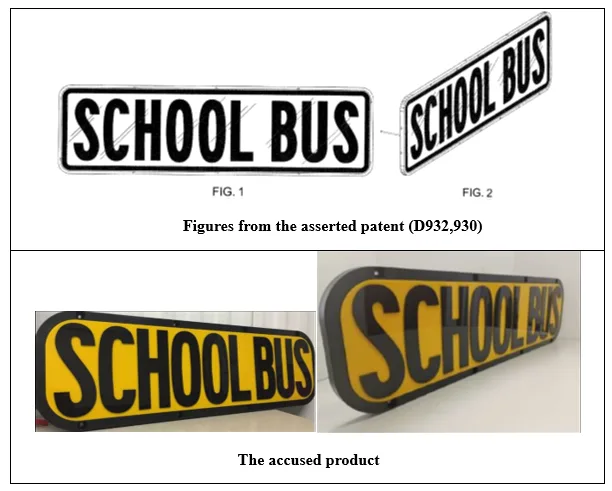
Note the oblique lines in the patent’s figures. While a design patent’s scope is primarily defined by its figures, the title and—notably here—the description can also contribute. The patent’s description explains that “The oblique shading lines visible in the front and perspective views denote transparency.”
The interpretation of these oblique shading lines was a contentious issue at trial. Over Opti-Luxx’s objection, the district court found the oblique shading lines to cover both transparency and translucency, and the jury’s finding of infringement was based on this interpretation. But on appeal, this finding was overturned in a November 2025 decision. The Federal Circuit pointed out that the Manual of Patent Examining Procedure permits oblique shade lines “to show transparent, translucent and highly polished or reflective surfaces, such as a mirror,”[2] and considered that Smartrend’s use only of “transparency” in describing its oblique lines was expressly narrowing:
The claims, here, are limited to surfaces that possess transparency. Transparency is not synonymous with translucency and does not mean both transparent and translucent.[3]
Due to the mis-construction of “transparency,” the Federal Circuit vacated the judgment of infringement, and remanded for a new trial.
The Federal Circuit’s decision reinforces that careful reflection is needed when drafting a design application that could include transparent, translucent, or reflective surfaces. First, and most fundamentally, a design applicant should be certain that it is in their strategic interest to claim transparency, translucency or reflectiveness, as opposed to omitting oblique shading lines and remaining agnostic to the ornamentation of the surface.
Assuming though that the applicant does want to use oblique shading lines, based on the Federal Circuit’s decision it would be wise to entirely omit any special description of the oblique shading lines. The Federal Circuit considers that one of skill in the art “would know, from the MPEP, [that oblique shading lines] might show transparent, translucent and highly polished or reflective surfaces.”[4] So describing their use in the specification is unnecessary, and only risks narrowing their interpretation relative to the MPEP’s expansive description. If an applicant nevertheless finds it in their interest to describe the oblique lines, they should consider reciting both transparency and translucency (and highly polished or reflective, if applicable) to avoid an unintentionally narrow interpretation.
The second cautionary case is a few years older. In Think Green v. Medela,[5] Think Green asserted its design patent for a silicone breast milk collector against Medela:
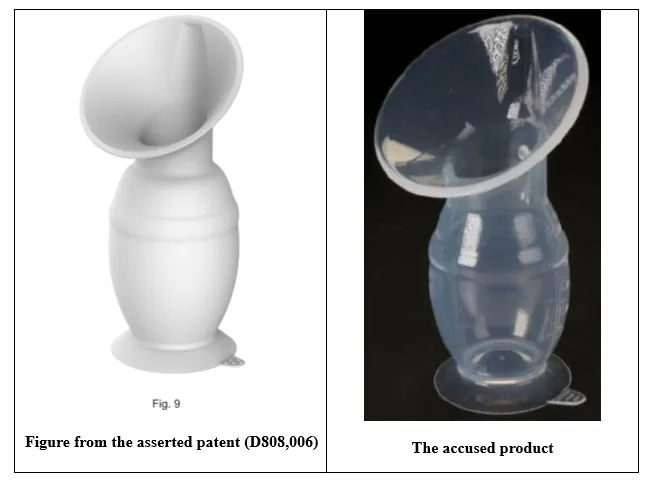
Medela moved for summary judgment of non-infringement. Here the interpretation of the surface character of the design was also at issue, but in a different way. Think Green’s patent drawings took the form of a computer-generated image, not a line drawing. Think Green took the position that their design patent was agnostic as to surface material or characteristics, and so should cover the transparency seen in the accused product. The district court disagreed. It considered that Think Green’s choice to use a computer-generated image with opaque surfaces constituted a choice to claim that the surfaces are opaque:
a deliberate choice of image with an unmistakable appearance of opacity must be understood to manifest an intention to claim an opaque object.[6]
Having decided that Think Green’s patent was limited to an opaque object, and given that Medela’s accused product was transparent, the court found Medela’s product plainly dissimilar and granted Medela summary judgment of noninfringement. A more detailed summary of this case can be found in Sterne Kessler’s 2022 Design Patents Year in Review.
While not a Federal Circuit decision, the Think Green case still provides a reasonable caution against using computer-generated digital renderings if the applicant does not intend to be limited by the appearance of the surfaces shown. To protect a design with coverage that is truly agnostic as to surface appearance, particularly with regard to opacity, line drawings are best.
[1] Smartrend Manufacturing Group (SMG), Inc. v. Opti-Luxx Inc., 2025 WL 3165603 (Fed. Cir. 2025).
[2] Manual of Patent Examining Procedure § 1503.02(II).
[3] Smartrend v. Opti-Luxx.
[4] Id. (internal citations omitted).
[5] Think Green Limited v. Medela AG and Medela LLC, 2022 WL 6123348 (N.D. Ill.).
[6] Id.
Related Services
Receive insights from the most respected practitioners of IP law, straight to your inbox.
Subscribe for Updates